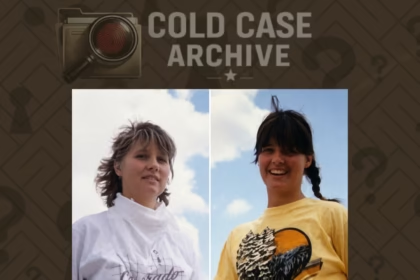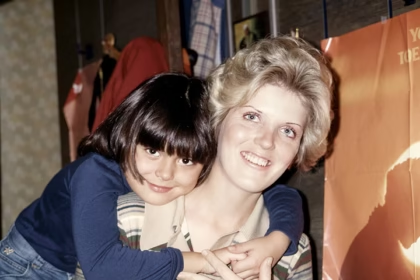



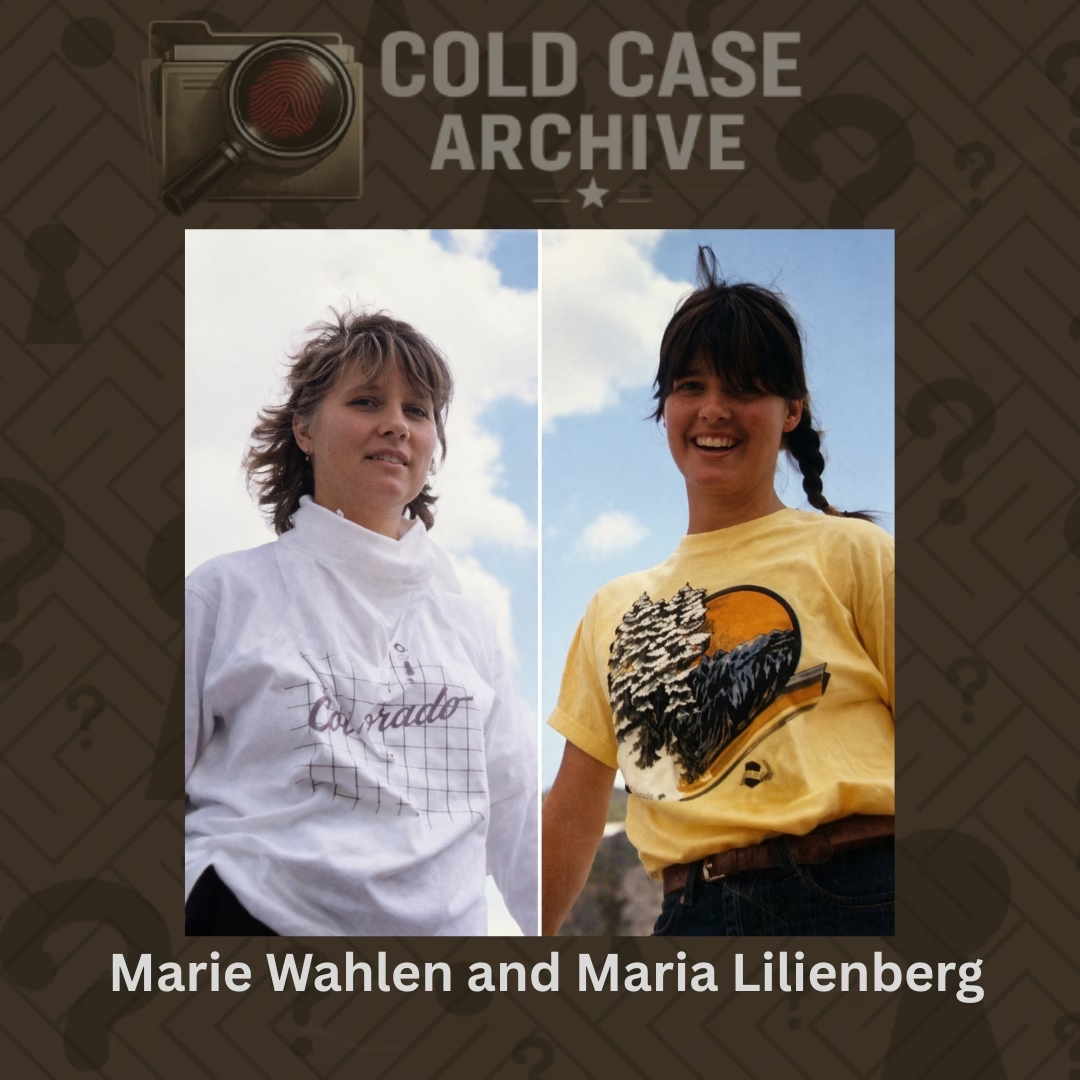

Swedish Tourists Cold Case California: Marie Lilienberg and Maria Wahlen
Swedish tourists cold case California is a search phrase that closely fits one of the most haunting unsolved murder cases of the 1980s. In July 1983, two young women from Sweden—Marie Lilienberg and Maria Wahlen—set out on what should have been the final leg of a summer trip through California. Instead, their journey ended in tragedy, and the case has remained unsolved for decades.
Their story is one that still resonates because it combines so many elements that define a chilling cold case: international victims, a vanished travel route, discarded personal belongings, a remote body recovery site, and years later, an anonymous tip that seemed promising but never led to charges. Even after media coverage, police interest, and public attention, the person responsible for their deaths was never officially identified in court.
For readers of Cold Case Archive, this case stands out not only because of its brutality, but because of the many unanswered questions surrounding the final days of the two travelers. Who picked them up while they were hitchhiking? Why were their belongings found separately from where their bodies were discovered? And did the mysterious caller years later truly know the identity of the killer?
This article takes a careful, respectful, and fully original look at the case of Marie Lilienberg and Maria Wahlen, including their background, the timeline of events, the major clues, the later anonymous tip, and why this case still deserves attention today.
Who Were Marie Lilienberg and Maria Wahlen?
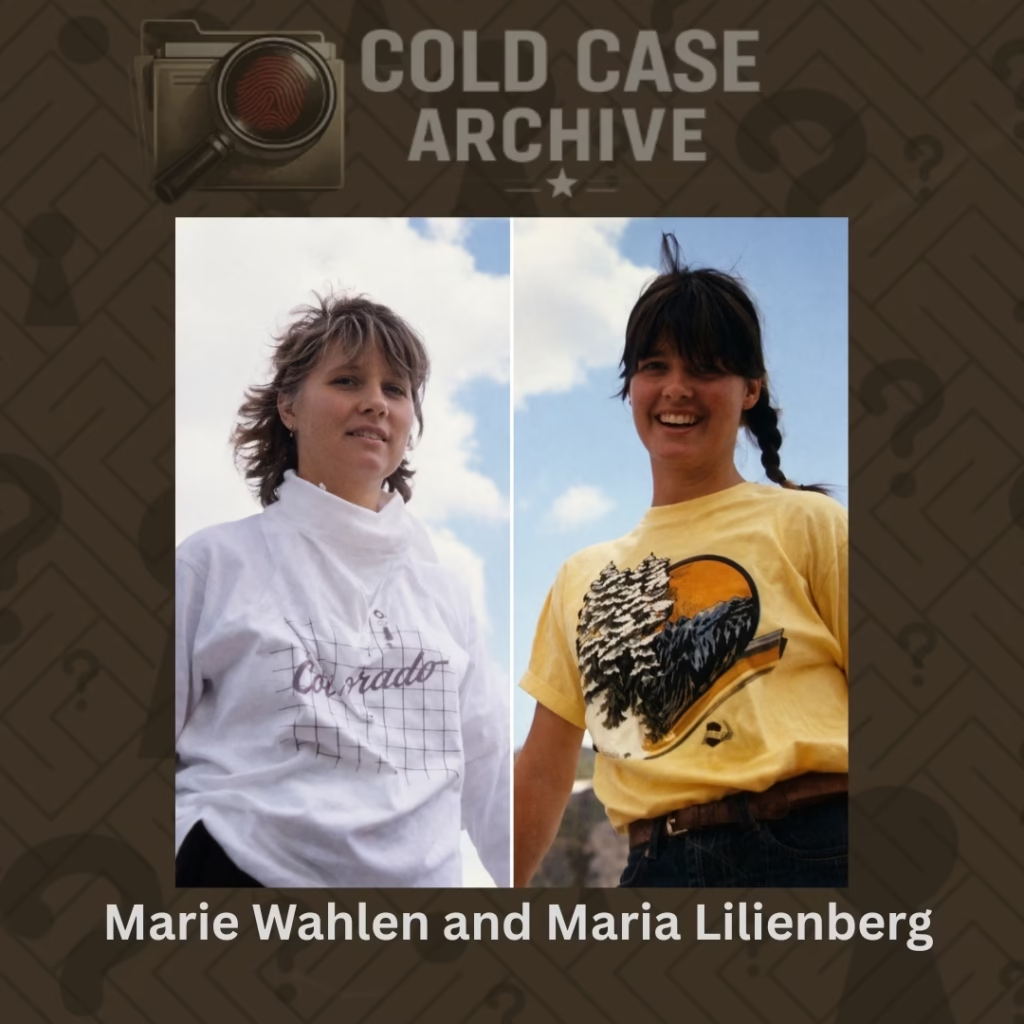
Marie Lilienberg and Maria Wahlen were two young Swedish women whose lives were cut short while traveling in the United States in 1983.
Marie Lilienberg was from Danderyd, Sweden. She was 23 years old at the time of her death and had reportedly been studying to become a gymnastics teacher. Maria Birgitta Wahlen, age 25, was from Alingsås, Sweden and worked as a preschool teacher.
Both women were described as adventurous young travelers. They had come to the United States as part of a working and travel experience, something many young adults do while exploring the world and earning money along the way. Their plans were simple and relatable: work for a season, travel during the summer, and return home with memories of a meaningful adventure.
Instead, they became victims in a case that remains one of the most haunting unsolved murders involving foreign tourists in California.
How the Two Swedish Travelers Met
Marie Lilienberg and Maria Wahlen first met in January 1983 while working as maids at a ski resort in Vail, Colorado. Seasonal resort jobs often bring together young international workers, and that appears to have been the case here.
Although they came from different parts of Sweden, they quickly formed a connection. Marie had reportedly visited the United States before, while Maria was experiencing the country for the first time. That difference may have made their friendship even stronger—one had more familiarity with American travel, and the other was seeing it all as a new adventure.
After the ski season ended, the two traveled to Hawaii together. Later, they decided to spend more time exploring the California coast before returning home. Their trip reflected the spirit of youth travel in the early 1980s: flexible plans, low budgets, and trust in the goodwill of strangers.
That trust, sadly, may have placed them directly in harm’s way.
Their Summer Journey Through the United States
By the summer of 1983, Marie and Maria were reaching the final stage of their time in America. They had worked, traveled, and seen more of the country than many visitors ever do. But they were also reportedly low on money in their last days, with only about $50 left between them.
Because of limited funds, they chose to hitchhike along the California coast rather than pay for more expensive transportation. At the time, hitchhiking still carried less stigma in some parts of Europe than it did in the United States. Many observers later pointed out that Sweden was seen as a more trusting society, where young women may not have viewed the practice with the same level of danger.
That cultural gap became part of the case’s wider story. American media coverage at the time often emphasized that the victims may not have fully understood how risky hitchhiking could be in parts of the U.S., especially when traveling long distances.
Their final plan was to head to Los Angeles, then catch a flight to New York, and from there return to Sweden.
They never made it to either flight.
The Final Trip: Hitchhiking Through California
The women’s intended route took them from Northern California to Los Angeles. It was meant to be a temporary final travel stretch before going home.
They had reportedly been staying with an acquaintance in Redwood City, someone they had met earlier in Colorado. On July 22, 1983, they left that location and began the hitchhiking trip south.
This is the point where the known timeline becomes much darker.
There is no confirmed public account of exactly who picked them up after they left Redwood City. There is also no complete public map of where they stopped, who saw them, or whether they traveled in one vehicle or multiple vehicles. Like many cold cases involving transient travel, a crucial stretch of time exists in which the victims’ movements become difficult to trace.
That gap has haunted investigators and case followers ever since.
When They Were Last Seen
Marie Lilienberg and Maria Wahlen were last confirmed seen on July 22, 1983, when they departed from Redwood City.
They were reportedly planning to reach Los Angeles and board a flight to New York in just two days. This detail is important, because it suggests they were traveling with a deadline. They likely intended to move quickly and may have accepted rides more readily in order to stay on schedule.
Maria Wahlen had also kept a detailed diary of the pair’s travels. The final known diary entry was dated July 21, 1983, just one day before they disappeared.
That diary would later become one of the most meaningful personal items linked to the case.
The Discovery of Their Belongings
A major early clue emerged on the very day they were supposed to leave for New York.
Several belongings belonging to the women were reportedly found in a dumpster behind a business near a freeway in Commerce, Los Angeles County. This discovery raised immediate concern because it suggested that something had gone badly wrong before they could complete their travel plans.
Among the recovered items were:
- Maria Wahlen’s diary
- Two undeveloped rolls of film
- Other personal belongings connected to the women
Police later processed the film in hopes that the photographs might reveal clues about where the women had been, who they had met, or what they had experienced in the days before their deaths.
The dumpster location has always stood out as a key piece of the mystery. If the women had been harmed elsewhere, why were their belongings discarded there? Was the killer passing through Los Angeles? Was the dump site chosen at random? Or did it suggest the victims had at some point reached Southern California before their lives were taken?
The placement of the items created as many questions as it answered.
The Search by Their Families
Back in Sweden, the families of both women became increasingly alarmed when communication stopped.
The fathers of the victims—Ove Lilienberg and Lars Wahlen—had reportedly stayed in regular contact with their daughters by phone until mid-July. When the calls stopped and the women failed to return as planned, concern quickly turned into fear.
At the beginning of August 1983, the fathers traveled to California to search for their daughters. Their efforts brought emotional weight to the case and helped draw media attention. They appealed publicly for information and tried to piece together their daughters’ last known movements in a foreign country far from home.
For families of missing persons, one of the hardest realities is not knowing whether a loved one is stranded, injured, hiding, or dead. In this case, the uncertainty lasted until a grim discovery later that month.
The Discovery in Los Padres National Forest
On August 18, 1983, deer hunters discovered two badly decomposed bodies in Los Padres National Forest, about 25 miles east of Santa Maria, California. Some retellings placed the area near Santa Barbara, but the recovery site was in a remote forest region that made the crime scene even more disturbing.
Because the remains were in an advanced state of decomposition, identification reportedly had to be confirmed using dental records brought from Sweden.
The women had been stabbed to death, and reports also indicated they had been sexually assaulted. Due to exposure and animal activity in the wilderness, the condition of the bodies was especially severe by the time they were found.
This was no longer a missing persons case. It had become a homicide investigation involving two foreign nationals, a likely travel-related abduction or attack, and a suspect who had disappeared without a trace.
The location of the body recovery site added another layer to the mystery. A remote forest east of Santa Maria was not an obvious stop on a straight route from Redwood City to Los Angeles. That suggests the women may have been taken off course, lured away, or transported by someone with knowledge of isolated areas.
Why the Case Drew National Attention
The murders of Marie Lilienberg and Maria Wahlen gained substantial media attention in the United States in 1983 for several reasons.
1. The Victims Were Young Foreign Tourists
Cases involving international travelers tend to receive greater press coverage because they cross national boundaries and affect audiences in more than one country.
2. The Circumstances Were Especially Disturbing
The women had been traveling home, their belongings were discarded separately, and their bodies were found in a remote wilderness area.
3. The Story Reflected a Broader Fear
During the 1970s and 1980s, America saw many publicized cases involving hitchhikers, roadside predators, and serial offenders moving between states. This case fit into a growing public fear about vulnerable travelers.
4. Their Families Were Publicly Searching for Answers
The image of two fathers traveling from Sweden to California to look for their missing daughters made the tragedy even more heartbreaking.
The case remained in public conversation for a time, but like many unsolved murders, it gradually lost momentum and went cold.
The Anonymous Tip That Reopened Interest
Years later, the case received renewed attention because of a phone call.
On September 26, 1991, an anonymous caller contacted the Swedish consulate in San Diego and claimed to have information about the murders. According to reports, the caller said he knew a Canadian man named Loren who drove through San Diego each year on his way to Mexico.
The caller allegedly said that Loren hated women and had once admitted encountering two Swedish women in 1983 who had tried to trick or con him.
This tip was significant for several reasons:
- It came years after the murders
- It named a possible suspect
- It implied direct knowledge of a confession or admission
- It revived public interest in the case
The phone call eventually helped bring the murders to a wider audience again, including a feature on Unsolved Mysteries in 1992.
Police later identified both the anonymous caller and the man referred to as Loren. Even so, no charges were ever filed.
That fact remains one of the most frustrating aspects of the entire case.
Who Was “Loren”?
The man identified in the anonymous tip was described as Canadian and said to have red hair. According to the call, he regularly traveled through San Diego on his way to Mexico and had a deep hostility toward women.
Law enforcement later identified the individuals connected to the tip, but the suspect was never publicly charged with the murders of Marie Lilienberg and Maria Wahlen.
This leaves several possibilities:
- Investigators may not have had enough physical evidence
- The tip may have included true details but lacked proof
- The suspect may have denied involvement
- The witness information may not have held up under scrutiny
- Investigators may have believed he was suspicious but could not build a prosecutable case
Cold cases often hinge on a narrow line between suspicion and proof. In this case, the tip appears to have created momentum, but not enough to bring closure.
The Loren Herzog Theory
Over time, some people began speculating that the “Loren” named in the call may have been Loren Herzog, a California serial killer whose name became associated with multiple murders.
However, that theory has significant problems.
According to the case details, the caller described Loren as Canadian and red-haired. Loren Herzog reportedly did not match that description well, had no known Canadian connection, and would have been only 17 years old in 1983.
Some observers still mention Herzog because one of his later victims was reportedly assaulted and stabbed in a manner that seemed broadly similar. But similarity in method alone is not enough to prove involvement, especially in violent crimes where such patterns are unfortunately not unique.
So while Herzog remains a name often mentioned in online discussions, the connection has never been officially confirmed and should be treated carefully.
Why the Case Remains Unsolved
Despite media coverage, physical evidence, and a later tip, the murders of Marie Lilienberg and Maria Wahlen remain unsolved. There are several likely reasons why.
Limited Witness Trail
The women were traveling by hitchhiking, which meant they likely interacted with strangers outside formal systems like ticket counters or hotel check-ins. That makes reconstruction of their final movements extremely difficult.
Remote Crime Environment
The bodies were discovered in a forested area, which may have reduced the amount of recoverable evidence and increased environmental damage to the scene.
Delayed Identification and Forensic Limits
Although the women were identified through dental records, forensic science in the early 1980s was far more limited than it is today. DNA technology was not used the way it is now, and evidence collection standards were different.
Separate Evidence Locations
Their belongings were found in a different place from where their bodies were discovered. That split may indicate movement by the killer and complicate timeline reconstruction.
Anonymous Tip Without Strong Enough Proof
Even when a lead sounds compelling, investigators still need evidence that can stand up in court. That may have been missing here.
Key Questions That Still Have No Answers
Many aspects of the case remain unknown. Among the biggest unanswered questions are:
Who picked them up after Redwood City?
This is arguably the most important missing piece in the case. If investigators could establish the identity of the driver or drivers who encountered the women that day, the case could look very different.
Did they ever safely reach Los Angeles?
The discovery of their belongings in Commerce suggests some link to the Los Angeles area, but it is still unclear whether the women themselves reached that area alive.
Was the killer local or passing through?
The body recovery site and the dumpster location could suggest someone familiar with California highways, but that still leaves open whether the offender was local, transient, or part of a longer travel route.
Was the anonymous caller telling the full truth?
The caller clearly knew enough to attract police interest. But was he reporting a real confession, repeating a rumor, or mixing fact with exaggeration?
Does modern forensic testing still hold potential?
If preserved evidence exists, advances in DNA and forensic genealogy could offer hope, depending on the condition and handling of the materials.
Why This Cold Case Still Matters Today
The murders of Marie Lilienberg and Maria Wahlen continue to matter for several reasons.
First, they remain unresolved. Any case involving two young women whose lives were taken while traveling deserves continued attention.
Second, this case reflects a broader category of unsolved crimes involving tourists, hitchhikers, and victims who cross jurisdictions. These cases are often harder to solve because the victims are far from home, witnesses are scattered, and the timeline is fragmented.
Third, renewed public attention can still help. Even after decades, someone may remember a conversation, a vehicle, a suspicious behavior, or a name that seemed unimportant at the time. Cold cases have been solved with less.
Finally, there is a human reason. Marie and Maria were not just names in an archive. They were daughters, friends, workers, travelers, and young women with plans to return home. Their case is not only about the mystery of what happened. It is also about remembering who they were.
Final Thoughts
The Swedish tourists cold case California remains one of the most troubling unsolved murder cases connected to 1980s travel crime in the United States. Marie Lilienberg and Maria Wahlen came to America for work, friendship, and adventure. They should have returned to Sweden with stories and photographs. Instead, their journey ended in violence, and their families were left with decades of grief and uncertainty.
The known facts paint a heartbreaking picture: a final trip south, a missed flight, personal belongings found discarded near a freeway, and bodies discovered in a remote forest weeks later. Then, years after the crime, an anonymous caller introduced a possible suspect named Loren—yet even that lead failed to bring justice.
For cold case readers, this is the kind of file that stays with you. It has a timeline, clues, public appeals, and a possible lead, yet no resolution. That combination is exactly why it remains important to document, preserve, and revisit.
If future forensic work, archived evidence review, or renewed witness attention ever brings new answers, the story of Marie Lilienberg and Maria Wahlen may finally move from mystery to resolution. Until then, it remains one of California’s haunting unsolved cases involving foreign travelers.
FAQ
What happened to Marie Lilienberg and Maria Wahlen?
Marie Lilienberg and Maria Wahlen were two Swedish tourists who disappeared in California in July 1983 while hitchhiking south. Their bodies were later found in Los Padres National Forest, and the case remains unsolved.
Where were Marie Lilienberg and Maria Wahlen last seen?
They were last known to have been seen in Redwood City, California, on July 22, 1983, as they began traveling toward Los Angeles.
Where were their belongings found?
Some of their belongings, including a diary and undeveloped film, were reportedly found in a dumpster near a freeway in Commerce, Los Angeles County.
Was anyone ever charged in the case?
No. Although an anonymous tip in 1991 named a man called Loren, no one was ever charged with the murders.
Is Loren Herzog officially linked to the case?
No. Some have speculated about a connection, but it has never been officially confirmed.
Why is this case still discussed today?
It remains discussed because it involves two young international travelers, a brutal unsolved crime, a later anonymous tip, and many unanswered questions.
Disclaimer
The content presented in this article is based on publicly available information and is intended for informational and educational purposes only. While every effort has been made to ensure accuracy, details surrounding ongoing or unsolved cases may change over time as new information becomes available.
This article does not intend to make accusations, assign guilt, or interfere with any active investigation. Any individuals mentioned are presumed innocent unless proven guilty in a court of law.
The views and interpretations expressed are those of the writer and do not represent official statements from law enforcement agencies or affiliated organizations.
This content may include sensitive topics related to crime and violence. Reader discretion is advised.
If you have any information related to this case, please contact the appropriate local authorities.
Case Source:
This case information was compiled from publicly available sources, including official records, news reports, and case archive websites such as wikipedia This article is intended for informational and educational purposes only, and all information is based on sources believed to be accurate at the time of writing.