


Cold Case That Continues to Haunt a Jacksonville Family More Than Three Decades Later
The Diana Snodgrass unsolved murder remains one of the most haunting cold cases in North Florida’s history. More than 35 years have passed since this vibrant, loving mother was taken from her family under violent and mysterious circumstances, and yet no one has ever been held accountable for her death. Her loved ones continue to carry the weight of that loss every single day, holding on to cherished memories while simultaneously grappling with the painful reality that justice has never been served.
This article takes an in-depth look at the life of Diana Lynne Snodgrass, the devastating night she disappeared, the stalled investigation that followed, and the lasting impact her death has had on the people who knew and loved her most. The Diana Snodgrass unsolved murder is a case that deserves renewed public attention, and her family hopes that even after all these years, someone with information will finally come forward.
Who Was Diana Snodgrass? A Life Full of Light, Love, and Laughter
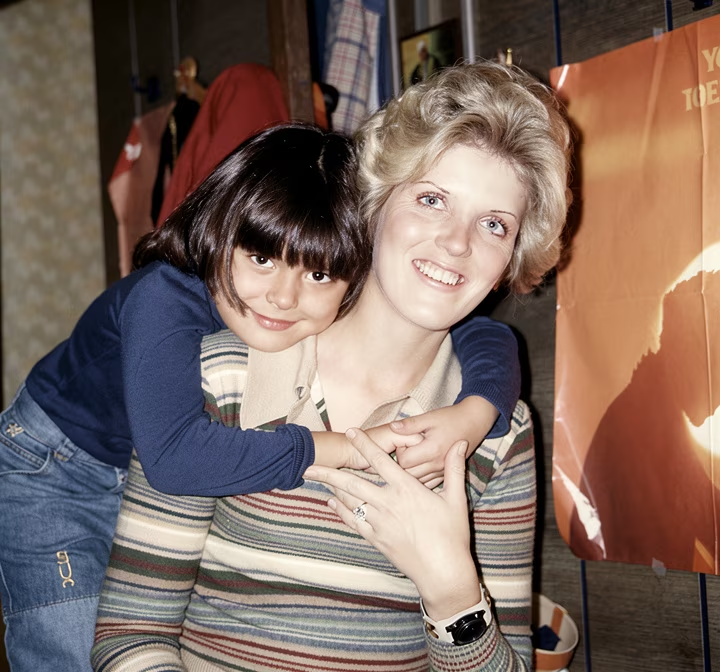
To understand the full weight of the Diana Snodgrass unsolved murder, it is essential to first understand the kind of person Diana was. She was not just a name on an unsolved case file — she was a daughter, a mother, a sister, a friend, and a woman who brought genuine joy to everyone fortunate enough to know her.
Diana was born as the eldest daughter in her family and quickly earned the affectionate nickname “Deedee” among her four siblings. From a very young age, she stepped into the role of caretaker, helping her mother look after her younger brothers and sisters. This responsibility was not something imposed on her reluctantly — Diana embraced it wholeheartedly. She was a natural nurturer, someone whose maternal instincts seemed to be woven into the very fabric of who she was.
In the summer of 1967, Diana and her family relocated from Columbus, Indiana, to Jacksonville, Florida. The family made the long journey by Greyhound bus, and even during that trip, Diana took on the task of helping manage her younger siblings. Once they settled in Jacksonville, specifically near the Five Points area in the Riverside neighborhood, Diana quickly became a fixture in the local community. She and her brothers and sisters could often be found running around the neighborhood, playing with other children, and forging friendships that would last for years.
Her younger sister, Pamela Zelinka, has described Diana as someone who had an enormous circle of acquaintances. She attracted people with her warmth, her humor, and her infectious energy. While Pamela acknowledged that not all of those friendships were necessarily positive influences, there was no denying that Diana had a magnetic personality that drew people to her.
A Woman of Many Talents and Boundless Energy
Diana Snodgrass was far more than just a social butterfly. She was a woman of remarkable talent and determination. Among her many skills, she was an extraordinarily gifted seamstress who could create beautiful garments with precision and care. She was also a phenomenal cook, a talent that she shared generously with her family and friends. In fact, she had recently begun exploring catering as a side business, using her culinary abilities to bring joy to others in a professional capacity.
But perhaps her most well-known passion was dancing. Diana loved music, and she had a particular fondness for country music, especially the songs of George Strait. Whenever she was in a dance hall with those familiar tunes filling the air, she came alive in a way that was unforgettable to anyone who witnessed it. Pamela vividly recalls one particular evening when she accompanied Diana to a local club. As the music played, Diana glided across the dance floor with a grace and effortlessness that left her sister in awe. She was, by all accounts, an absolutely stunning dancer.
In her daily life, Diana took great pride in her appearance. She was always well put together, with her hair styled perfectly and her outfits carefully chosen for each occasion. Like many women who call Florida home, she enjoyed soaking up the sun and working on her tan. During the warm summer months, she could often be seen driving around in her station wagon with all the windows rolled down, her hair taking on a naturally windswept look that suited her free-spirited nature perfectly.
Diana also had a clever way of keeping her hair in top shape without spending a fortune. She would regularly help clean a beauty salon that was operated by her mother’s closest friend, and in exchange, she would receive free perms. It was a practical arrangement that also reflected Diana’s resourcefulness and willingness to lend a hand wherever she could.
Above all else, Diana carried a beautiful smile that rarely left her face. No matter what challenges she faced or what kind of day she was having, she maintained a positive and cheerful demeanor that brightened the lives of those around her.
Motherhood and Family: The Center of Diana’s World
Central to the story of the Diana Snodgrass unsolved murder is the role she played as a devoted mother and family member. Diana became a mother for the first time when she was just sixteen years old, after becoming pregnant with her daughter Angela during a relationship with a high school boyfriend. Though Diana and Angela’s father did not remain together romantically, Diana threw herself into motherhood with complete dedication.
As she grew older, Diana eventually relocated to Virginia, where she married and welcomed another daughter. However, the marriage did not last. Although the union was never formally dissolved through legal proceedings, Diana and her husband separated, and she made the decision to return to Florida permanently. The move coincided with a period when her sister Nancy was getting married, and Diana felt drawn back to her roots and her family in Jacksonville.
Both of Diana’s daughters considered her their mother, and she loved them both deeply. After Diana’s tragic passing, her younger daughter went to live with her father, while Angela continued to carry her mother’s memory with her throughout her life.
During the summers, Angela would travel to Florida to spend time with Diana. Those visits were filled with trips to the beach, gatherings with close family friends, and the kind of simple, joyful moments that become treasured memories. For Angela, those summers represented some of the most meaningful time she ever spent with her mother.
Even beyond her role as a mother to her own children, Diana never relinquished the “little mom” title she had held since childhood. She remained deeply involved in the lives of her siblings, always looking out for them and offering support whenever it was needed. Pamela has spoken with deep admiration about Diana’s parenting abilities, noting that her sister was an exceptionally organized and attentive mother.
In one particularly telling anecdote, Pamela recalled that Diana never once lost a pair of socks — a feat that any parent can appreciate as nearly miraculous. It was a small detail, but it spoke volumes about the kind of meticulous, caring person Diana was in every aspect of her life.
Thanksgiving Memories: The Family’s Most Cherished Tradition
Among the many memories that Diana’s family holds dear, Thanksgiving stands out as the most significant. It was the family’s favorite holiday, and Diana played a central role in making it special every single year. Together with her mother, Diana would spend the entire day in the kitchen, preparing an elaborate feast that brought the whole family together.
Pamela has fond memories of those Thanksgiving celebrations, and she has singled out one dish in particular as her all-time favorite: Diana’s green bean casserole. It was a simple dish in many ways, but Diana prepared it with such care and skill that it became the highlight of the meal for Pamela.
Those Thanksgiving gatherings were about far more than just food, however. They were occasions for the family to come together, share stories, catch up on each other’s lives, and enjoy the warmth of being surrounded by people who loved one another. The family also had a generous tradition of inviting friends who had nowhere else to go, ensuring that no one had to spend the holiday alone.
Angela and Pamela both look back on those Thanksgivings with deep nostalgia. Those were the days when the family was whole, when laughter and conversation filled the house, and when Diana’s presence made everything feel complete. The loss of those traditions in the wake of the Diana Snodgrass unsolved murder has been one of the many quiet tragedies the family has endured.
The Night Everything Changed: July 27, 1990
The events that transformed the Diana Snodgrass unsolved murder from a family’s worst nightmare into a decades-long quest for answers began on a warm summer evening in late July 1990. Diana had just celebrated her 33rd birthday approximately one week earlier, and she was enjoying a night out at a local establishment she frequented regularly.
The bar was called the Beer Witch, and it was located near Diana’s apartment complex on Lane Avenue in Jacksonville. It was a place where Diana felt comfortable, a familiar spot where she could unwind and socialize with friends. On the night of July 27, 1990, Diana was at the Beer Witch doing exactly that — enjoying the company of people she knew and having what should have been an ordinary evening out.
At some point during the night, Diana was seen leaving the bar. She appeared to be getting into a vehicle, and those who saw her assumed she was heading to a friend’s house to spend the night. No one could have known at the time that this would be the last time Diana Snodgrass would ever be seen alive.
What happened in the hours that followed remains shrouded in mystery. The details of how Diana ended up where she was ultimately found, or who was responsible for her death, have never been established with certainty. It is this void of information — this terrible, frustrating gap in the story — that defines the Diana Snodgrass unsolved murder and keeps it painfully open for her family.
The Discovery and the Devastating News
Diana’s body was discovered the following morning, on July 28, 1990. She was found near the US-129 exit off Interstate 10, in the vicinity of Live Oak, Florida — a location that was a significant distance from the Jacksonville bar where she had last been seen. The circumstances of how and why she ended up so far from where she started that evening have never been fully explained.
The discovery made the local news. On Sunday, a newspaper published a front-page article describing an unidentified deceased woman who had been found by authorities. The article included a physical description of the victim, and it was this description that would deliver the devastating blow to Diana’s family.
On July 29, 1990, the day after Diana was found, her mother came across the newspaper article. As she read the description of the unidentified woman, a terrible recognition washed over her. She knew, with the gut-wrenching certainty that only a mother could possess, that the article was describing her eldest daughter. Diana was gone.
Angela, Diana’s daughter, learned of the tragedy while she was staying at the home of a close family friend. She had not heard from her mother since Diana had been heading out to work on the 27th. The silence that had initially seemed unremarkable suddenly took on a horrifying significance.
The pain of that revelation — of learning that a beloved mother, sister, and daughter had been violently taken from the world — is something that has never fully healed for Diana’s family. The Diana Snodgrass unsolved murder did not just claim one life; it shattered the lives of everyone who loved her.
A Stalled Investigation and a Family Left Waiting
In the immediate aftermath of Diana’s death, law enforcement began investigating the case. However, the investigation soon faced a significant obstacle that had nothing to do with the case itself. In August 1990, just weeks after Diana’s body was discovered, a series of horrific murders occurred in Gainesville, Florida. Those killings, which targeted college students, generated massive media coverage and demanded enormous resources from law enforcement agencies across the region.
As public attention and investigative resources shifted to the Gainesville murders, the Diana Snodgrass unsolved murder case was effectively pushed to the side. For Diana’s family, it felt as though their loved one’s case had been placed on a back burner, overshadowed by crimes that were deemed more urgent or more newsworthy.
That sense of being forgotten was deeply painful for the family, compounding the grief they were already experiencing. Over the years, however, they have come to terms with the circumstances and no longer harbor resentment toward law enforcement. Instead, they have chosen to focus their energy on gratitude — gratitude that Diana’s body was found at all, that they were able to lay her to rest, and that her case, while unsolved, has not been entirely forgotten.
Still, the lack of resolution weighs heavily. The Diana Snodgrass unsolved murder remains an open wound that time has been unable to fully close. Without answers, without accountability, the family is left in a perpetual state of uncertainty that makes true healing nearly impossible.
The Lasting Impact on Diana’s Family
The ripple effects of the Diana Snodgrass unsolved murder have touched every member of her family in profound and lasting ways. In the words of Pamela, the family’s response to the tragedy can be summed up simply: “We fell apart.”
The grief was overwhelming and all-consuming. Diana had been such a central figure in the family — the big sister, the caretaker, the one who held everyone together — that her absence left a void that could never be filled. Each family member processed the loss in their own way, but the collective impact was devastating.
Perhaps no one was affected more deeply than Diana’s mother. According to Pamela, her mother was fundamentally changed by the loss of her eldest daughter. The woman she had been before Diana’s death was gone, replaced by someone who carried the weight of unimaginable sorrow for the rest of her days. “My mother was never the same… ever,” Pamela has said, and those words carry a depth of meaning that is difficult to fully comprehend.
For Pamela personally, the month of July has become a time of particular difficulty. The anniversary of Diana’s death casts a shadow over the entire month, turning what should be a time of summer warmth and joy into a period of painful reflection. She visits Diana’s grave regularly, but even that act of remembrance has become complicated by external circumstances. The cemetery is located in the Normandy area of Jacksonville, which Pamela says has become too dangerous for her to visit by herself. It is a cruel irony that even the simple act of honoring her sister’s memory has been made more difficult by the passage of time.
The tragedy has also fundamentally altered Pamela’s relationship with the world around her. She admits that she has developed a deep-seated difficulty in trusting strangers. She finds herself constantly on guard around unfamiliar people, a defensive posture that was born directly from the violence that took her sister’s life. While she acknowledges that this heightened vigilance is a harsh way to live, she sees it as an unavoidable consequence of what her family has endured.
Despite all of this, Pamela refuses to let grief consume her entirely. She still allows herself to look back on her memories with Diana with fondness and warmth. She chooses to remember the dancing, the laughter, the Thanksgiving feasts, and the countless small moments that made Diana such a special person. It is a delicate balance — honoring the pain while also celebrating the joy — and it is one that Pamela navigates with remarkable strength.
Angela’s Journey: Growing Up Without Her Mother
For Angela Harris, Diana’s eldest daughter, the Diana Snodgrass unsolved murder represents a loss that reverberates through every stage of her life. Diana’s death occurred during the summer before Angela’s senior year of high school, at a time when Angela was visiting Florida. She was at the cusp of adulthood, on the verge of some of the most formative experiences of her young life, and suddenly the person she needed most was gone.
Angela has acknowledged that she does not remember many of the specific details from the immediate aftermath of her mother’s death. The shock and trauma of the experience have blurred many of those early days into an indistinct haze of grief. However, there is one memory from the funeral that remains crystal clear in her mind.
During the service, a man appeared whom no one in the family recognized. He was well-dressed, wearing a pair of nice jeans and a crisp shirt, and his presence immediately drew attention. When Angela had the chance to speak with him, he explained that his friends had encouraged him to attend the funeral to pay his respects. Diana, it turned out, had been his favorite waitress at a local restaurant. He shared a simple but touching memory: whenever Diana was the one working behind the counter, he knew the coffee was going to be exceptional.
It was a small, seemingly insignificant detail, but it spoke to the kind of impact Diana had on the people around her. Even a regular customer at a restaurant felt compelled to honor her memory, to travel to her funeral and share a kind word about the woman who had brightened his mornings with a perfect cup of coffee and a warm smile. That moment has stayed with Angela for decades, a reminder that her mother’s light touched far more lives than she may have ever realized.
Today, Angela resides in Indiana, but she makes a point of traveling to Florida on a regular basis. Her visits serve multiple purposes — reconnecting with family, revisiting familiar places, and tending to her mother’s headstone. She has said that while her trips are not solely about her mother, thoughts of Diana are never far from her mind, particularly during the quiet, reflective moments. Standing on a Florida beach, listening to the waves, she finds herself transported back to those summer visits of her youth, when she and Diana would spend carefree days by the water.
The passage of time has softened the sharpest edges of Angela’s grief, but it has also brought with it a different kind of sorrow — the sorrow of missed opportunities. Angela has expressed deep regret that she lost her mother at such a young age, at a time when she was still too immature to fully appreciate the relationship they had. She has described her teenage self as being at “a bratty age,” and she wishes desperately that she could have had the chance to grow into adulthood alongside Diana, to develop the kind of deep, equal friendship that mothers and daughters often forge when the child becomes an adult.
That longing — to see her mother at this stage of life, to know her not just as a parent but as a fellow woman and friend — is perhaps the most poignant aspect of Angela’s experience with the Diana Snodgrass unsolved murder. It is a reminder that murder does not just end a life; it erases an entire future of possibilities, of relationships that will never develop, of conversations that will never take place, of memories that will never be made.
Honoring Diana’s Memory: How Her Family Keeps Her Spirit Alive
Despite the pain that surrounds the Diana Snodgrass unsolved murder, her family has found meaningful ways to keep her memory alive and honor the person she was.
For Pamela, one of the most important rituals takes place every Thanksgiving. In tribute to her sister, Pamela makes sure to enjoy a generous serving of green bean casserole — the dish that Diana was famous for preparing during their family holiday celebrations. It is a small gesture, but it carries enormous emotional significance. Each bite is a connection to those long-ago Thanksgivings when the family gathered around the table, when Diana and their mother spent the entire day in the kitchen, and when everything felt right in the world.
Beyond personal rituals, the tragedy has also shaped the way Pamela interacts with others who are experiencing similar pain. She has developed a profound respect and empathy for the families of violent crime victims, a perspective that could only have been gained through firsthand experience. She understands the unique, isolating nature of that kind of grief — what she calls “the sea of grief” — and she makes a conscious effort to reach out to others who are drowning in it before they go under completely.
This compassion, born from the worst experience of her life, is perhaps Diana’s most enduring legacy through her sister. Pamela has channeled her pain into purpose, using her own suffering to help ease the suffering of others. She has learned to be strong, to keep moving forward, and to continue living not just for herself but for Diana. It is not easy — Pamela would be the first to admit that — but it is her way of ensuring that Diana’s death, while senseless, was not entirely without meaning.
The Ongoing Need for Answers: Why the Diana Snodgrass Unsolved Murder Still Matters
More than three decades have passed since that terrible night in July 1990, and the Diana Snodgrass unsolved murder remains exactly that — unsolved. No arrests have been made. No one has been charged. The person or persons responsible for ending Diana’s life have never been held accountable for their actions.
Cold cases like the Diana Snodgrass unsolved murder present unique challenges for law enforcement. As years and decades pass, witnesses move away or pass on, memories fade, and physical evidence can degrade. But they are not hopeless. Advances in forensic technology, particularly in the area of DNA analysis, have led to breakthroughs in cases that were once considered permanently cold. Renewed public interest, often sparked by media coverage or advocacy efforts, can also bring new tips and leads to the surface.
The Diana Snodgrass unsolved murder is a case that could benefit from exactly this kind of renewed attention. Somewhere, someone may hold a piece of information that could crack this case open. It might be a detail that seemed insignificant at the time — a conversation overheard, a suspicious vehicle spotted, a change in someone’s behavior in the days following Diana’s death. Even the smallest piece of the puzzle could be the one that makes everything else fall into place.
Diana’s family has never given up hope that justice will one day be served. They continue to speak about her case, to share her story, and to encourage anyone with relevant information to come forward. Their persistence is a testament to the depth of their love for Diana and their commitment to ensuring that her life — and her death — are not forgotten.
How You Can Help Solve This Case
If you have any information that could be relevant to the Diana Snodgrass unsolved murder, authorities urge you to come forward. No tip is too small, and even information that may seem unimportant could prove crucial to advancing the investigation.
You can contact the Suwannee County Sheriff’s Office at (386) 362-2222 to share any information you may have.
If you prefer to remain anonymous and would like the possibility of being eligible for a reward, you can reach out to Crime Stoppers at (386) 208-8477.
Diana Lynne Snodgrass deserved a long and happy life. She deserved to see her daughters grow into women, to hold grandchildren in her arms, to dance to George Strait songs for decades to come. That future was stolen from her, and the person responsible has walked free for more than 35 years. It is never too late for justice, and it is never too late to do the right thing. If you know something, please speak up. Diana’s family is still waiting for answers.
Conclusion: Remembering Diana and Refusing to Forget
The Diana Snodgrass unsolved murder is far more than a cold case number in a filing cabinet. It is the story of a real woman — a talented, warm, generous person who brought light into every room she entered. It is the story of a family torn apart by violence, struggling to rebuild their lives in the absence of someone who can never be replaced. And it is the story of a community’s failure, thus far, to deliver the justice that Diana and her family deserve.
Diana Snodgrass was a devoted mother, a loving sister, a gifted cook, a beautiful dancer, and a loyal friend. She was taken from this world far too soon, and the circumstances of her death remain shrouded in unanswered questions. But her family refuses to let her be forgotten, and neither should we.
Every unsolved murder represents an unfinished chapter — a story that demands a conclusion. The Diana Snodgrass unsolved murder has been waiting for its conclusion for more than three decades. Perhaps, with enough awareness, enough compassion, and enough courage from those who may hold the key to the truth, that conclusion will finally come.
Until then, Diana’s family will continue to remember her the way she deserves to be remembered: with love, with laughter, and with a heaping side of green bean casserole every Thanksgiving.
Disclaimer
This article is based on publicly available information from news reports, public records, and case archive sources. The content is provided for informational and educational purposes only.
Cold Case Archive does not claim that any individual mentioned is guilty of a crime unless officially confirmed by law enforcement or a court of law. Any suspects or persons discussed are referenced strictly based on publicly available reports.
Some details may be summarized or presented in a simplified manner for clarity and readability. While we strive for accuracy, we do not guarantee the completeness or timeliness of the information, as cases may evolve over time.
This website does not intend to defame, harm, or misrepresent any individual, living or deceased. If you are a family member, legal representative, or authority and believe that any content should be corrected or removed, please contact us and we will review the request promptly.
Case Source:
This case information was compiled from publicly available sources, including official records, news reports, and case archive websites such as Project Cold Case. This article is intended for informational and educational purposes only, and all information is based on sources believed to be accurate at the time of writing.