



Brazil’s Darkest Crimes: The Shocking Case of Francisco das Chagas
The francisco das chagas serial killer case is one of the most disturbing and widely discussed criminal investigations in modern Brazilian history. Often referenced in discussions of the brazil child serial killer case, the crimes linked to Francisco das Chagas Rodrigues de Brito spanned multiple years, crossed state lines, and left a lasting impact on families in Maranhão and Pará, Brazil. Investigators and prosecutors connected him to a long series of child killings between 1991 and 2003, with estimates typically placing the number of victims between 30 and 42.
This case is also frequently associated with the maranhao child murders brazil and the altamira emasculation murders, two phrases that continue to appear in reporting and crime archives because of the similarities in victim profile and alleged method. While the details are deeply unsettling, it is important to discuss the case in a factual, careful, and professional way. For the purposes of this article, the focus will remain on the investigation, legal process, and historical significance, without graphic descriptions.
At its core, the francisco das chagas serial killer investigation exposed major failures in child protection, policing, and institutional response. Many of the victims came from poor communities, and critics argued that the disappearances did not receive urgent attention early enough. As more cases were connected, the scale of the crimes shocked Brazil and raised questions about how such a pattern could continue for so long.
The story of Francisco das Chagas Rodrigues de Brito is not just about one offender. It is also about vulnerable children, delayed investigations, public pressure, and the long fight for accountability. In this article, we will examine who he was, how the crimes developed over time, what evidence led to his arrest, how the courts handled the case, and why the brazil child serial killer case still stands as one of the country’s most notorious criminal chapters.

Who Is Francisco das Chagas?
Francisco das Chagas Rodrigues de Brito was born in 1964 in Caxias, Maranhão, Brazil. Before his name became associated with one of the country’s most notorious criminal cases, he was known as a mechanic and, in some reports, a bicycle mechanic who lived a relatively ordinary public life. That ordinary appearance became one of the reasons the case alarmed so many people. By outward appearance, he did not fit the exaggerated image many people expect when thinking about a serial offender.
Background and Early Life
Publicly available summaries of the case present Francisco das Chagas as a working-class man from Maranhão who later moved through regions connected to the crimes under investigation. Compared with some other infamous offenders, there is relatively limited widely circulated information about his childhood and early development. Still, his adult life placed him in areas where a number of child disappearances and murders occurred, particularly in Maranhão and Pará.
The fact that he worked as a mechanic matters because it gave him the image of someone familiar and approachable in local communities. In cases involving child victims, offenders often rely on trust, routine contact, or perceived harmlessness to avoid early suspicion. That appears to have been a relevant factor here as well.
Personal Life Overview
Although the public record is stronger on the criminal investigation than on his private relationships, reports suggest that Francisco das Chagas was able to move through communities without drawing immediate widespread alarm. That is a common feature in long-running serial cases: the offender blends into daily life while operating in a pattern that remains unrecognized or unconnected for years.
In the francisco das chagas serial killer case, this ability to appear unremarkable may have allowed him to approach families and children in ways that did not instantly trigger fear. Several later witness statements and court discussions suggested that he presented himself as helpful, familiar, or engaged in ordinary local activity.
Behavioral Traits
Investigators and court-related reports frequently described him as manipulative, deceptive, and emotionally detached. Some psychological assessments and prosecutorial descriptions highlighted traits often associated with psychopathy, including:
- lack of empathy
- repeated lying
- attempts at self-justification
- inconsistent or self-serving statements
- calm behavior in situations where remorse might be expected
These alleged traits became significant in understanding how the brazil child serial killer case unfolded over such a long period.
Victims and Crime Pattern
The most painful aspect of the maranhao child murders brazil investigation is the age and vulnerability of the victims. Reports linked to Francisco das Chagas consistently focused on young boys, many from poor or marginalized communities. Their disappearances often did not receive the immediate large-scale response that cases involving wealthier families might have generated, and that disparity became one of the central criticisms of the entire investigation.
Victim Profile
The victims connected to the francisco das chagas serial killer case were primarily boys, often adolescents or younger minors. Many came from families with limited resources, and this social reality affected both the early search efforts and the amount of media attention some disappearances received at the time.
When cases involving children occur repeatedly in the same broader region, investigators typically look for shared factors such as:
- age group
- gender
- neighborhood or travel route
- last known contact
- similar disappearance circumstances
In this case, those patterns gradually became too strong to ignore.
Locations: Maranhão and Pará
The crimes associated with Francisco das Chagas are most strongly linked to Maranhão, especially areas around São Luís, Paço do Lumiar, and São José de Ribamar. However, the case also overlaps with Pará, particularly due to the alleged connection to the altamira emasculation murders.
That cross-state dimension is one reason this case became so notorious. It was not confined to one small area or one brief period. Instead, investigators and prosecutors came to believe that a much broader pattern existed, stretching across years and state borders.
Pattern Consistency
One of the reasons authorities were able to connect so many cases was the reported consistency in victim type and crime pattern. While it is not necessary to describe these acts graphically, the broad pattern described by investigators included:
- targeting boys
- luring them away under plausible pretexts
- attacks taking place away from public view
- concealment of bodies or remains
- repeated forensic and circumstantial similarities across cases
The altamira emasculation murders became part of the conversation because authorities and commentators noted similarities in modus operandi and regional movement.
Luring Victims
Reports from the case indicate that some victims may have been lured with offers related to simple tasks, food, fruit gathering, work, or other ordinary activities. This detail is critical because it reflects a pattern seen in many crimes against children: the offender does not rely on sudden force in public, but rather on familiarity, persuasion, or opportunity.
In one especially important case discussed during court proceedings, the victim had reportedly told others he was going to meet the mechanic before he disappeared. That statement became highly relevant in building the case against Francisco das Chagas.
Evidence Found
A major turning point in the brazil child serial killer case came when investigators reportedly found remains and bone fragments connected to missing children at or near the suspect’s residence. This evidence was among the strongest reasons authorities were able to move forward with formal charges and connect him to multiple cases.
The discovery of physical evidence on his property significantly changed the direction of the investigation. Before that point, many disappearances had remained unresolved, and families had struggled for answers.
Timeline of Crimes (1991–2003)
The timeline connected to the francisco das chagas serial killer case stretches from 1991 to 2003, making it one of the longer-running serial crime investigations in Brazil.
1991: Early Cases in the Broader Pattern
Prosecutors later stated that some of the killings linked to Francisco das Chagas may date back to 1991. At that stage, however, individual disappearances were not yet necessarily recognized as part of a single pattern. This is common in serial investigations, especially when victims come from different neighborhoods, municipalities, or social backgrounds.
Early to Mid-1990s: Growing Concern
As more boys disappeared in parts of Pará and Maranhão, concern began to build among local families and communities. In some areas, rumors and fear spread faster than formal investigative coordination. This period is also where the alleged overlap with the altamira emasculation murders becomes especially important, since that series had already raised alarm in Pará.
Late 1990s: Escalation and Missed Opportunities
By the late 1990s, the number of unresolved cases had become increasingly difficult to dismiss as isolated incidents. Yet criticism later focused on the fact that the investigations were not always handled with the urgency and coordination the pattern demanded.
Advocacy groups and human rights voices argued that if the victims had come from more privileged backgrounds, stronger pressure and faster intervention might have come earlier. This criticism remains central to discussions of the maranhao child murders brazil.
1997 Onward: Cases in Maranhão Gain More Attention
Authorities later linked a number of murders in Maranhão to the suspect, particularly in and around:
- São Luís
- Paço do Lumiar
- São José de Ribamar
Investigators revisited older disappearances and unsolved murders as evidence began to point toward a repeat offender.
2003: Final Phase and Break in the Case
The final major turning point came in December 2003, when the disappearance and killing of a boy identified in reporting as Jonahtan/Jonathan dos Santos or Jonathan Silva Vieira brought new attention to the suspect. Witness accounts and last-seen information reportedly placed the child with Francisco das Chagas before the disappearance.
This case was particularly important because prosecutors considered it one of the strongest from an evidentiary standpoint.
Discovery of Remains
Following intensified investigation, authorities reportedly discovered remains buried beneath the dirt floor of the suspect’s shack or on the grounds of his residence. Additional remains connected to missing children were also discussed in reports and legal proceedings.
That discovery was a decisive breakthrough. Cases that had once been treated separately were now being tied together with physical evidence.
Police Involvement and Arrest
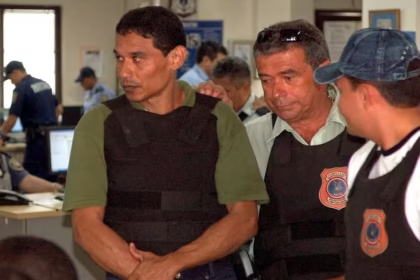
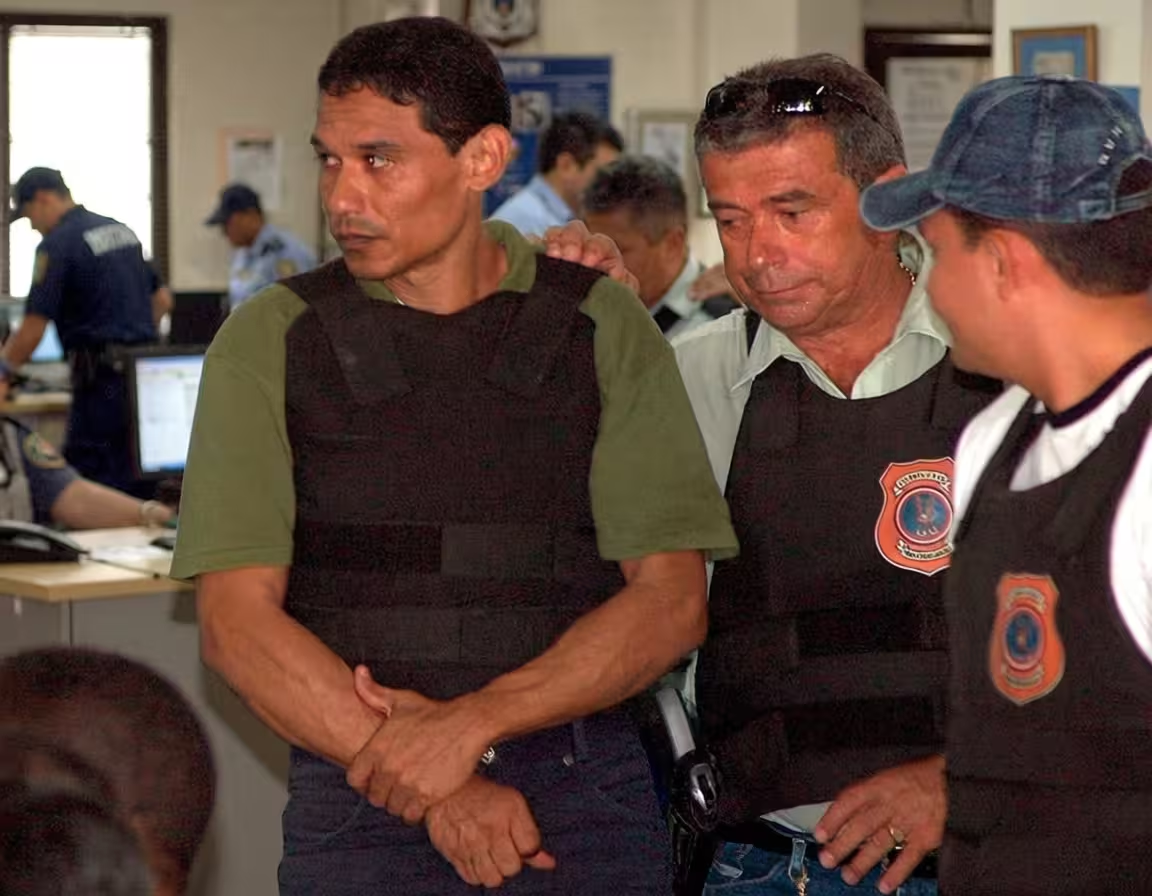
Francisco das Chagas was ultimately apprehended in December 2003, though some reports note formal charging and expanded legal action continuing into 2004 as investigators built out the full scope of the case.
Police involvement deepened rapidly after evidence from the final cases, witness testimony, and the discoveries at his residence created a much stronger prosecutorial foundation.
Evidence Leading to Arrest
The arrest in the francisco das chagas serial killer case did not rely on one single piece of evidence alone. Instead, it emerged from a combination of witness statements, disappearance patterns, recovered remains, and the suspect’s own inconsistent accounts.
Witness Statements
One of the most important components involved witness testimony indicating that at least one victim had planned to meet with Francisco das Chagas before vanishing. Family members later testified about those last-known interactions, helping investigators reconstruct the final movements of the child.
Forensic Discoveries
The discovery of bones and remains at or near the suspect’s residence was among the most damaging evidence. This shifted the case from suspicion to something much more concrete and gave investigators a basis for connecting multiple disappearances.
Pattern Link Analysis
Authorities also relied on crime pattern analysis, including:
- victim similarities
- geographical overlap
- long-term movement of the suspect
- consistency across multiple cases
This was especially relevant in arguments linking him to both the maranhao child murders brazil and the altamira emasculation murders.
Statements and Retractions
Reports indicate that Francisco das Chagas at times confessed to killings and at other times retracted or altered those statements. Such inconsistency is not unusual in major serial investigations, but it complicates public understanding of what exactly was admitted and what had to be established independently through evidence.
Because of that, the strongest case against him rested not just on statements, but on physical evidence and prosecutorial findings.
Trial and Convictions
The legal process in the brazil child serial killer case was extensive and complex, in part because of the large number of alleged victims and the geographical spread of the crimes.
Charges
Francisco das Chagas Rodrigues de Brito faced charges including:
- qualified homicide
- concealment of corpses
- abuse of dead bodies
These charges reflected the prosecution’s view of the seriousness and repeated nature of the crimes.
Court Proceedings
One of the first major trials focused on the murder of a 15-year-old victim because prosecutors believed it was the case with the strongest evidence. This strategic decision is common in major serial cases. When authorities have dozens of potential linked crimes, they often begin with the case most likely to secure a conviction.
The trial reportedly lasted a little over two days and drew major public attention. Interest was so intense that the proceedings were held in a larger venue because the standard courtroom could not accommodate all the families and observers.
Confessions Mentioned Carefully
At the opening of one trial, reports stated that Francisco das Chagas confessed to one killing and suggested that trauma from his own childhood abuse influenced his actions. He also reportedly claimed not to remember many details.
It is important to handle this point carefully. A confession may be legally significant, but in complex serial cases, especially where statements are later changed or retracted, courts still rely heavily on corroborating evidence.
Sentencing Details
In one widely reported conviction, he received:
- 19 years for homicide
- 1 year and 8 months for concealing the body
The sentence could have been higher, but the judge reportedly reduced it after psychiatric evaluations suggested a mental disorder that affected his full control over his actions.
This did not mean he was found innocent or not responsible. Rather, it reflected how the court weighed mental health evidence during sentencing.
Additional Cases
At the time of those early rulings, Francisco das Chagas still faced many additional cases tied to killings between 1991 and 2003. The scale of the alleged crimes meant the legal process was never about just one victim or one isolated event.
Psychological Profile
The psychological dimension of the francisco das chagas serial killer case remains one of the most discussed and debated aspects.
Psychopathic Traits
Reports from investigators and prosecutors often described him as showing psychopathic characteristics, including:
- lack of visible remorse
- manipulative behavior
- lying
- attempts to rationalize his conduct
- emotional coldness
These traits, if accurately assessed, may have helped explain how he maintained a public façade while allegedly committing repeated crimes over many years.
Mental Disorder Claims
At the same time, psychiatric evaluations reportedly indicated that he suffered from a mental disorder and was not fully in control of his actions at all times. This became relevant during sentencing and public debate.
The coexistence of psychopathic traits and mental disorder claims can create confusion in public discussion. These are not identical concepts. Courts often must weigh whether a defendant understood the nature of the crime, could control behavior, and should be considered fully or partially responsible under the law.
Behavioral Analysis
From a behavioral standpoint, the case suggests several recurring offender characteristics:
- selection of vulnerable victims
- repeated use of trust or approachability
- movement across more than one region
- concealment efforts
- persistence over many years
This pattern indicates an offender capable of planning and repetition rather than purely impulsive violence.
Public Reaction and Impact
The public response to the maranhao child murders brazil and the altamira emasculation murders was intense, emotional, and long-lasting.
Fear in Communities
Families in Maranhão and Pará lived with enormous fear as more boys disappeared. Parents became more cautious, rumors circulated, and many communities were left wondering whether authorities had lost control of the situation.
Media Attention
As the case gained wider attention, it became one of the most infamous child murder investigations in Brazil. The combination of a high victim count, vulnerable children, and possible connections across states made it a major national story.
Impact on Families
For relatives of the victims, the case was not just a criminal proceeding. It was a years-long struggle for truth, dignity, and accountability. Many families believed they had been ignored in the early stages and had to fight to keep attention on the disappearances.
Human Rights Pressure
One of the most significant developments was the criticism directed at Brazilian authorities by rights organizations. The lack of timely clarification in the murders and the perception of neglect contributed to denunciations before the Inter-American Court of Human Rights system connected to the OAS.
That international dimension shows how serious the institutional concerns became. The issue was no longer just one criminal case, but also whether the state had failed in its duty to protect vulnerable children.
Controversies and Criticism
No overview of the brazil child serial killer case is complete without addressing the controversies.
Delayed Investigations
One of the strongest criticisms was that police and other institutions did not act with enough urgency when children from poor families began disappearing. Critics argued that warning signs were missed and that stronger early coordination might have saved lives.
Treatment of Poor Victims
Local human rights groups accused authorities of not doing enough because many of the victims were poor. This criticism remains one of the most painful and politically significant parts of the case.
Confession Reliability
Because Francisco das Chagas reportedly confessed and later retracted statements in some instances, questions have remained about which admissions were fully reliable and which were strategic, confused, or inconsistent.
Scope of Responsibility
Another area of controversy involves how definitively he can be linked to every case attributed to him. While he was considered responsible in court for multiple homicides and widely connected to a much larger pattern, large serial investigations often contain debate over exact victim counts. That is why sources often give a range of 30 to 42 victims rather than one universally accepted number.
Institutional Failures
Ultimately, the case is also remembered as a warning about what happens when repeated disappearances are not recognized early as a pattern. The consequences were devastating.
Why This Case Still Matters
The francisco das chagas serial killer case remains important for several reasons. First, it represents one of Brazil’s most extensive and horrifying serial child murder investigations. Second, it exposed how poverty and social marginalization can affect investigative priorities. Third, it highlighted the need for better inter-state coordination in tracking disappearances and linking patterns.
The overlap between the maranhao child murders brazil and the altamira emasculation murders also remains historically significant because it illustrates how crimes may be separated by geography but connected by offender behavior and movement.
For researchers, journalists, and readers of criminal history, this case stands as a reminder that serial violence is not only about the offender. It is also about the systems that fail to recognize danger, the communities left in fear, and the families who must carry loss long after headlines fade.
Key Facts Summary
- Full name: Francisco das Chagas Rodrigues de Brito
- Born: 1964
- Birthplace: Caxias, Maranhão, Brazil
- Occupation: Former mechanic / bicycle mechanic
- Country: Brazil
- States linked to case: Maranhão and Pará
- Victim count: Commonly reported as 30–42
- Victim profile: Young boys
- Timeline: 1991–2003
- Arrest/Apprehension: December 2003
- Charges: Homicide, concealment of corpses, abuse of dead bodies
- Related phrases: maranhao child murders brazil, altamira emasculation murders
- Case significance: One of Brazil’s most notorious serial child murder cases
Final Analysis
The francisco das chagas serial killer investigation remains one of the clearest examples of how a long-running pattern of violence can hide in plain sight when victims come from vulnerable communities. The scale of the brazil child serial killer case, the cross-state dimension involving Maranhão and Pará, and the overlap with the altamira emasculation murders make it historically significant far beyond Brazil.
Francisco das Chagas Rodrigues de Brito became a symbol of more than criminal brutality. His case also became a symbol of delayed justice, unequal attention, and the urgent need for better protection of at-risk children. The legal process established responsibility in multiple cases, but no conviction or sentence can erase the failures that allowed the crimes to continue over so many years.
For anyone studying serial crime, child protection, or justice system reform, this case remains essential reading. It is disturbing, tragic, and difficult to confront — but it also offers an important lesson: when disappearances are dismissed, patterns are missed, and vulnerable families are ignored, the consequences can be catastrophic.
FAQs
Who is Francisco das Chagas Rodrigues de Brito?
Francisco das Chagas Rodrigues de Brito is a Brazilian former mechanic convicted in cases involving the murders of children in Maranhão and linked to a broader pattern of killings in Maranhão and Pará.
How many victims were linked to Francisco das Chagas?
Most reports place the number between 30 and 42, which is why the francisco das chagas serial killer case is considered one of the largest serial murder investigations in Brazil.
Where did the crimes take place?
The crimes were linked mainly to Maranhão and Pará, Brazil.
What years did the crimes span?
Authorities connected the case to a period from 1991 to 2003.
What is the Altamira connection?
The case is often linked to the altamira emasculation murders because investigators and commentators noted similarities in the victim profile and alleged method.
How was Francisco das Chagas arrested?
He was arrested after a key disappearance investigation intensified suspicion, and police reportedly found remains and other evidence at or near his residence.
Was he convicted?
Yes. He was convicted in at least one major case and faced many additional charges tied to other murders.
Why is the case so important in Brazil?
The case is significant because of the high number of victims, the targeting of vulnerable children, and the criticism that authorities did not respond quickly enough to early disappearances.
Disclaimer
The content presented in this article is based on publicly available information and is intended for informational and educational purposes only. While every effort has been made to ensure accuracy, details surrounding ongoing or unsolved cases may change over time as new information becomes available.
This article does not intend to make accusations, assign guilt, or interfere with any active investigation. Any individuals mentioned are presumed innocent unless proven guilty in a court of law.
The views and interpretations expressed are those of the writer and do not represent official statements from law enforcement agencies or affiliated organizations.
This content may include sensitive topics related to crime and violence. Reader discretion is advised.
If you have any information related to this case, please contact the appropriate local authorities.
Case Source:
This case information was compiled from publicly available sources, including official records, news reports, and case archive websites such as NBC News. This article is intended for informational and educational purposes only, and all information is based on sources believed to be accurate at the time of writing.