


The Locked Bag Mystery: The Unsolved Death of Gareth Williams
The Gareth Williams locked bag mystery remains one of the most perplexing unsolved intelligence agent deaths UK has ever witnessed. When investigators discovered the body of a brilliant mathematician and intelligence operative sealed inside a sports bag in his London apartment, they uncovered a case that would challenge every conventional explanation. The MI6 spy death unexplained case continues to generate questions more than a decade after the discovery, with forensic impossibilities, government secrecy, and conflicting official conclusions creating a puzzle that refuses resolution.
This examination of the Gareth Williams Pimlico case facts reveals a death so unusual that experts, coroners, and investigators have reached contradictory conclusions. Was it a tragic accident involving a private individual’s personal experimentation? Could it represent something far more sinister—an assassination concealed within layers of institutional secrecy? The circumstances surrounding this case offer a rare glimpse into the shadowy world of intelligence operations, where even death cannot escape classification.
The locked bag mystery serves as a stark reminder that some questions may never receive satisfactory answers, particularly when national security intersects with criminal investigation.
Who Was Gareth Williams?
Early Life and Academic Brilliance
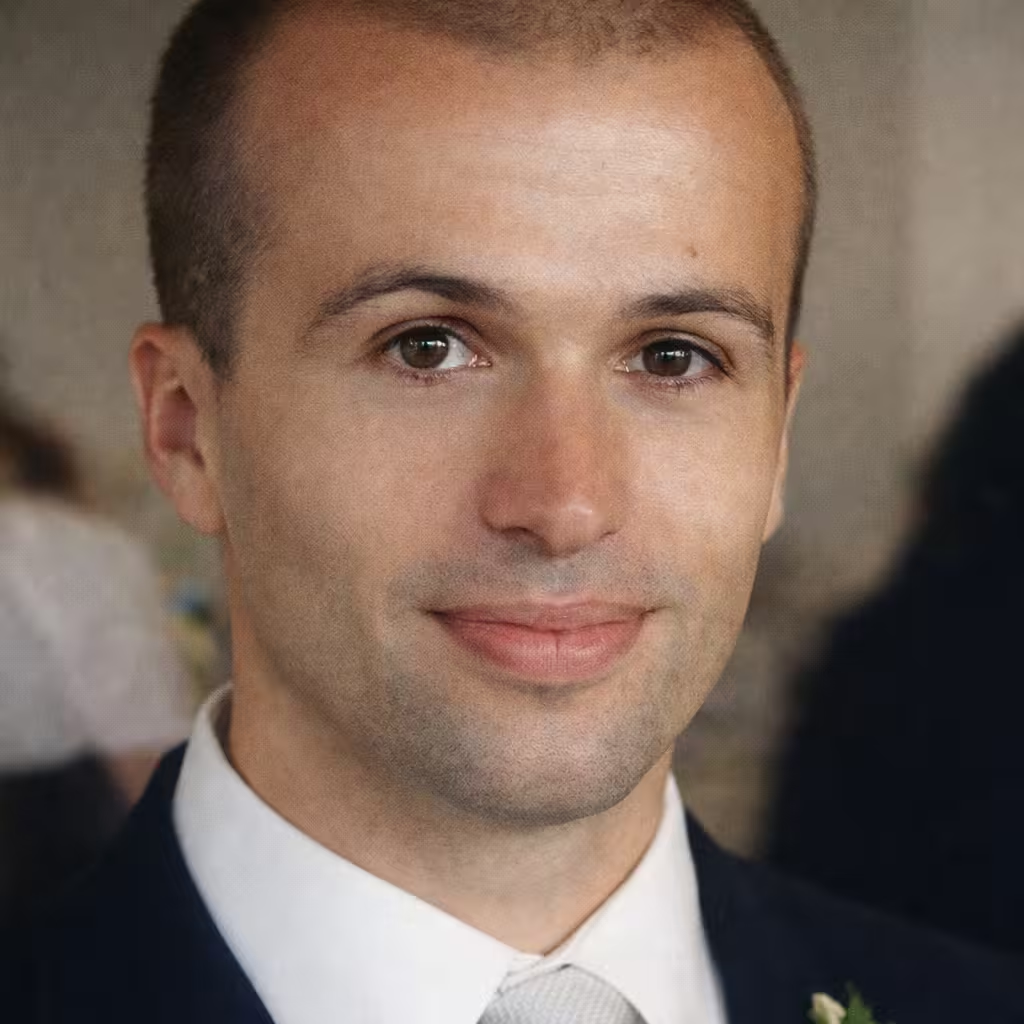
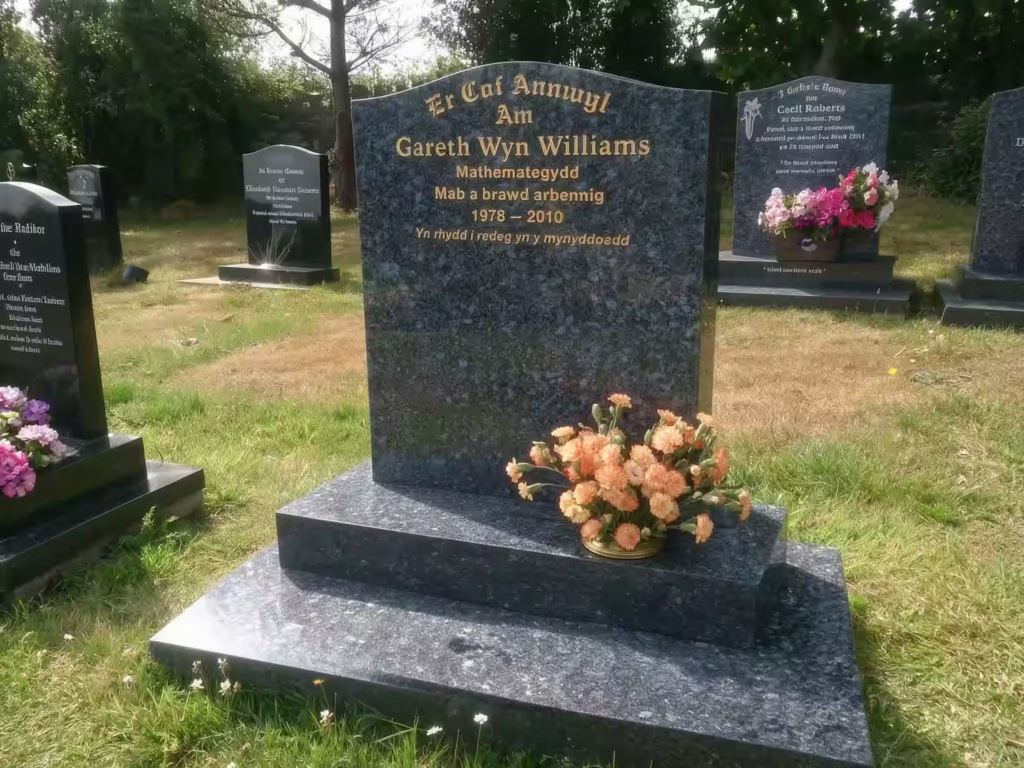
Gareth Wyn Williams entered the world on September 26, 1978, in Valley, Anglesey, Wales. From his earliest years, those around him recognized exceptional intellectual gifts that set him apart from his peers. Growing up in a Welsh-speaking household, Williams demonstrated remarkable mathematical aptitude that would define his educational trajectory.
His academic achievements defied conventional timelines. While still attending Ysgol Uwchradd Bodedern secondary school, Williams began part-time mathematics studies at Bangor University—an extraordinary arrangement that recognized his advanced capabilities. By age seventeen, he had completed his undergraduate degree with first-class honors, an accomplishment that typically takes students three to four years beyond the age Williams achieved it.
The young prodigy continued his academic journey at the University of Manchester, where he pursued doctoral studies in mathematics. Though he later withdrew from a subsequent postgraduate program at St. Catharine’s College, Cambridge, his intellectual credentials remained impeccable. Those who knew him described a reserved, intensely private individual whose mental faculties operated at levels few could match.
Career in Intelligence
In 2001, the Gareth Williams locked bag mystery subject began his career with the Government Communications Headquarters (GCHQ) in Cheltenham, one of Britain’s three primary intelligence and security agencies. For nearly a decade, Williams worked in the specialized field of cyber intelligence, applying his mathematical expertise to some of the nation’s most sensitive security challenges.
Williams rented accommodation in Prestbury, Gloucestershire, living quietly while pursuing his passion for cycling through the countryside. Colleagues and acquaintances uniformly described him as deeply private, methodical, and dedicated to his work. His technical skills in encryption, code-breaking, and cyber operations made him a valuable asset in an era of rapidly evolving digital threats.
In 2009, Williams received a secondment to the Secret Intelligence Service (SIS), commonly known as MI6, marking a transition from the signals intelligence work of GCHQ to the human intelligence operations of Britain’s foreign intelligence service. This MI6 spy death unexplained case would later reveal that Williams had recently qualified for operational deployment, suggesting his role had expanded beyond purely technical analysis.
Reports that emerged during the investigation indicated Williams had worked alongside American intelligence agencies, including the National Security Agency and the FBI. His assignments reportedly involved tracking international money-laundering operations, with specific focus on routes used by organized crime networks with connections to Moscow. He had attended specialized conferences on computer security, including the Black Hat Briefings and DEF CON gatherings in 2010, events that attract elite cybersecurity professionals and ethical hackers.
Despite his professional success in London, Williams had expressed desire to return to GCHQ headquarters in Cheltenham. He reportedly disliked aspects of the MI6 workplace culture and missed the countryside environments where he enjoyed cycling and walking. His scheduled return date was set for September 3, 2010—a transfer he would never make.
The Discovery That Raised Questions
Welfare Check and Entry into the Flat
The circumstances that led to the discovery in the Gareth Williams Pimlico case facts began with a concerning silence. When colleagues at MI6 noticed Williams had been absent and out of contact for several days, protocols were eventually activated for a welfare check. However, this response came only after a week of unexplained absence—a delay that would later draw sharp criticism during the official inquest.
On the afternoon of Monday, August 23, 2010, local police officers arrived at 36 Alderney Street in Pimlico, central London. The apartment was a top-floor flat used to house Security Service staff, located in an area known for its proximity to government institutions. Officers gained entry to the residence at approximately 4:48 PM, expecting perhaps to find an ill or incapacitated individual.
What they discovered instead would launch one of the most baffling investigations in the history of British intelligence.
The Locked Bag Scene
In the en-suite bathroom of the main bedroom, police found a red North Face sports holdall positioned in the bathtub. Inside this bag, officers discovered Williams’s naked, decomposing remains. The circumstances immediately struck investigators as profoundly unusual.
The sports bag had been secured from the outside with a padlock. More perplexingly, the key to that padlock was found inside the bag, beneath Williams’s body. This detail would become central to the enduring mystery of the case—how could someone lock themselves inside a bag with the key trapped inside with them?
The apartment showed no signs of forced entry. No evidence of a struggle appeared anywhere in the residence. The heating had been left running, which investigators later theorized may have accelerated the body’s decomposition, potentially obscuring forensic evidence.
The scene presented investigators with an immediate puzzle that defied simple explanation. The Gareth Williams locked bag mystery had begun in earnest, and every attempt to resolve it would only deepen the enigma.
The Forensic Puzzle
Lack of Evidence
The forensic examination of the Gareth Williams Pimlico case facts revealed a series of peculiarities that complicated efforts to determine what had occurred. Most notably, investigators found a remarkable absence of evidence one would typically expect at any scene where a person had been present and active.
No fingerprints were discovered on the bag’s exterior surfaces. Similarly, the padlock that secured the bag bore no identifiable fingerprints. Perhaps most significantly, investigators found no fingerprints on the rim of the bathtub—a surface one would almost certainly touch when climbing into a tub while maneuvering into a confined bag.
The body itself showed no injuries consistent with a struggle. Toxicology reports revealed no alcohol or common recreational substances in Williams’s system. The absence of defensive wounds or signs of physical confrontation suggested that if another party had been involved, Williams had not fought against them.
The apartment’s door locks and entry points showed no evidence of forced entry, though investigators noted that the door and lock mechanisms had been removed before forensic specialists could examine them in detail—a procedural failure that eliminated potentially crucial evidence.
DNA Findings and Controversies
Initial DNA analysis appeared to offer potential leads. Investigators discovered trace DNA material on the bag that did not match Williams’s genetic profile. These fragments suggested at least two other individuals might have had contact with the bag at some point.
However, this apparently promising evidence soon unraveled. DNA found on Williams’s hand turned out to be contamination from one of the forensic scientists handling the evidence—a serious procedural failure that cast doubt on other findings. The forensic company LGC later apologized for this error, acknowledging the additional pain it caused Williams’s family through incorrect data entry.
The other DNA traces remained inconclusive and partial, insufficient to generate reliable profiles that might identify specific individuals. Moreover, the DNA’s presence on the bag did not necessarily indicate involvement in Williams’s death, as the bag could have been handled by others at previous times unrelated to the fatal incident.
This MI6 spy death unexplained case demonstrated how even sophisticated forensic techniques can fail to provide clear answers when contamination and incomplete evidence compromise the investigation.
Could It Be Done Alone?
One of the most critical questions in the Gareth Williams locked bag mystery centered on physical possibility: Could someone lock themselves inside the bag from the inside, under any circumstances?
During the inquest, forensic experts attempted to replicate the feat. Two specialists made approximately 400 attempts to seal themselves inside an identical bag with the same type of padlock used in the Williams case. They failed in every attempt. While one expert acknowledged a theoretical possibility existed, the practical demonstration suggested it was virtually impossible for someone to accomplish alone.
The bag’s position within the bathtub added another layer of complexity. The dimensions and placement meant that someone entering the bag would need to manipulate the zipper and padlock while contorted in an extremely confined space, then somehow secure the lock from inside while ensuring the key remained in the bag.
Pathological evidence indicated Williams was likely alive when he entered or was placed in the bag. The position of his body suggested deliberate arrangement rather than the awkward positioning that would result from self-containment. Medical experts testified that once sealed inside, Williams would have succumbed to hypercapnia—elevated carbon dioxide levels—within two to three minutes, making any complex maneuvering in those final moments even more implausible.
No gloves were found in the bag with the body, yet the complete absence of fingerprints on the bag and padlock suggested someone had been careful to avoid leaving such evidence.
The Intelligence Angle
Sensitive Work and Secrecy
The Gareth Williams Pimlico case facts took on additional complexity due to the classified nature of the victim’s professional activities. Williams’s work touched some of the most sensitive areas of British and allied intelligence operations, creating inherent tensions between investigative transparency and national security.
Senior British police sources revealed that portions of Williams’s work concerned Russia, a detail that would later fuel speculation about foreign intelligence involvement. More specifically, reports indicated Williams had been assisting the United States National Security Agency in tracking international money-laundering networks. These financial routes were allegedly used by organized crime organizations, including criminal syndicates with connections to Moscow.
This work carried obvious risks. Money laundering investigations often expose powerful criminal organizations and potentially compromise individuals with significant resources and motivation to protect their operations. The international dimension added further complications, potentially bringing Williams to the attention of foreign intelligence services monitoring their own nationals’ activities.
Williams had recently completed training for operational deployment with MI6, suggesting his role had evolved beyond technical analysis toward active intelligence gathering. He had participated in efforts to penetrate computer hacking networks used by both state and criminal actors—work that required both technical sophistication and operational security.
Just months before his death, Williams attended two prominent cybersecurity conferences: the Black Hat Briefings and DEF CON. These gatherings attract elite cybersecurity professionals, government agents, and sometimes individuals operating in legal gray areas. His presence at these events indicated active engagement with cutting-edge cyber intelligence work.
Government Secrecy Measures
The investigation into this MI6 spy death unexplained case faced immediate complications from government secrecy requirements. Soon after the investigation began, the heads of the Secret Intelligence Service and the Metropolitan Police met to discuss how to balance investigative needs against the classified nature of Williams’s work.
The United States State Department formally requested that details of Williams’s work not emerge at the inquest. Given the reported collaboration between Williams and American intelligence agencies, this request reflected concerns about protecting ongoing operations and intelligence methods.
Foreign Secretary William Hague signed a public-interest immunity certificate, formally authorizing the withholding of specific details about Williams’s work and joint operations with allied intelligence services. This legal instrument allowed British intelligence agencies to keep classified information out of the public inquest proceedings, even as that inquest attempted to determine how and why Williams died.
Critics argued this secrecy prevented a full accounting of potential motives or threats Williams might have faced. Supporters countered that revealing operational details could compromise ongoing intelligence work and endanger other personnel. This tension between transparency and security would persist throughout the investigation and beyond.
The coroner herself noted that the possible involvement of intelligence service personnel in Williams’s death represented a legitimate line of inquiry for police, yet the very secrecy surrounding his work made such investigations extraordinarily difficult.
Theories Surrounding the Death
Theory 1 – Accidental Death
After a year-long reinvestigation, Metropolitan Police Deputy Assistant Commissioner Martin Hewitt announced the force’s conclusion: the “most probable scenario” was that Williams had died alone in his Pimlico flat as the result of accidentally locking himself inside the bag.
This conclusion rested on several factors. The apartment showed no signs of forced entry or struggle. No definitive forensic evidence pointed to another person’s presence at the time of death. While experts had failed to replicate the self-locking scenario in 400 attempts, police argued it remained theoretically possible that Williams had succeeded where others failed.
The police theory suggested Williams might have been engaging in some form of personal experimentation or unusual behavior that tragically went wrong. They noted he had entered the bag voluntarily (based on the absence of struggle indicators) and somehow managed to manipulate the locking mechanism in a way that trapped him inside.
Commissioner Hewitt specifically addressed the lack of fingerprints on the bathtub rim, stating it was “theoretically possible” for Williams to lower himself into the bag without touching that surface, though he did not explain how this would be physically accomplished.
The accidental death theory offered a resolution that avoided implications of criminal conspiracy or intelligence agency involvement, but it required accepting a scenario that forensic experts had demonstrated to be practically impossible.
Theory 2 – Third-Party Involvement
Coroner Fiona Wilcox reached a markedly different conclusion in her official inquest verdict. She found that Williams’s death was “unnatural and likely to have been criminally mediated,” expressing satisfaction “that on the balance of probabilities that Gareth was killed unlawfully.”
While insufficient evidence existed to deliver a formal verdict of unlawful killing, the coroner concluded that another party had placed the bag containing Williams into the bath and, on the balance of probabilities, locked the bag. She assessed that Williams was probably alive when placed in the bag and died shortly afterward from carbon dioxide poisoning or possibly from a short-acting poison.
The coroner’s reasoning centered on forensic impossibilities. The complete absence of Williams’s fingerprints on the padlock, bag, and bathtub rim suggested someone had either wiped these surfaces clean or Williams had never touched them in the manner one would expect during self-containment. The failed expert attempts to replicate the self-locking scenario further supported the third-party theory.
The coroner explicitly rejected theories involving suicide, bondage interest, cross-dressing, or auto-erotic activity as explanations for Williams’s death. She condemned media leaks about such matters as possible attempts at manipulation, noting that Williams’s occasional visits to bondage websites were infrequent and did not indicate active interest.
This theory left open the question of who the third party might be and what motivated the killing, but it firmly established that the evidence better supported criminal involvement than accident.
Theory 3 – Espionage and Assassination
The most dramatic theory surrounding the Gareth Williams locked bag mystery involves foreign intelligence assassination. In 2015, Boris Karpichkov, a former KGB agent who defected and resettled in Britain, made explosive claims about the case.
Karpichkov stated that “sources in Russia” had informed him that the Russian Foreign Intelligence Service (SVR) was responsible for Williams’s death. According to this account, the SVR had attempted to blackmail Williams into becoming a double agent. When Williams refused and allegedly claimed he knew “the identity of a Russian spy inside the GCHQ,” the SVR concluded they had “no alternative but to exterminate him to protect their agent.”
Regarding the method, Karpichkov claimed the SVR killed Williams using “an untraceable poison introduced in his ear”—a technique that would leave minimal forensic evidence and could explain the lack of struggle or defensive wounds.
This theory found some circumstantial support in the known facts of Williams’s work. His involvement in tracking Russian money-laundering operations and his reported work concerning Russia could have brought him to the attention of Russian intelligence. The sophistication required to kill someone while leaving minimal forensic evidence might suggest professional involvement rather than a random criminal act.
However, critics note that Karpichkov’s claims rely on unverifiable “sources” and lack supporting evidence. No poison was definitively identified in Williams’s system, though pathologists acknowledged that short-acting toxins might not be detectable after the decomposition that had occurred before discovery.
The espionage theory remains speculative but has never been conclusively disproven, particularly given the classified nature of Williams’s work and the secrecy surrounding intelligence operations.
Theory 4 – Personal Lifestyle Speculation
Media coverage of the Gareth Williams Pimlico case facts sometimes focused on aspects of Williams’s private life, generating speculation about personal activities that might explain the circumstances of his death.
Investigators revealed that Williams’s wardrobe included approximately £25,000 worth of high-end women’s clothing. Police also found that Williams had occasionally visited bondage-related websites, spending between thirty minutes and an hour on such sites, though they emphasized there was no evidence of obsession.
The landlady of Williams’s Cheltenham accommodation reported an incident from three years before his death when she and her husband found Williams shouting for help with his hands tied to bedposts. Williams explained he was testing whether he could free himself, which the landlady interpreted as either sexual experimentation or escapology practice.
These details led some to speculate that Williams might have died during some form of auto-erotic or escapology activity that went tragically wrong. However, the coroner explicitly and firmly rejected these theories.
The coroner noted that Williams’s visits to bondage websites were infrequent and intermittent, not indicating active interest or obsession. The presence of women’s clothing, while unusual, did not provide evidence of how Williams died. Most critically, the forensic impossibilities—particularly the inability of experts to replicate the self-locking scenario and the complete absence of fingerprints—could not be explained by personal lifestyle factors.
The coroner condemned leaks about these private matters as potential media manipulation, suggesting attempts to construct a narrative that diverted attention from more troubling possibilities.
The Coroner’s Verdict
In March 2012, Coroner Fiona Wilcox delivered her official verdict on this MI6 spy death unexplained case, concluding that Williams’s death was “unnatural and likely to have been criminally mediated.” This carefully worded finding reflected both her assessment of the evidence and the limitations she faced.
The coroner determined that on the balance of probabilities—the standard of proof in British civil proceedings—Williams had been killed unlawfully. However, she acknowledged that insufficient evidence existed to deliver a formal verdict of unlawful killing, which would require meeting a higher evidential threshold.
Wilcox’s key conclusions included:
- Another party most likely placed the bag containing Williams into the bathtub
- On the balance of probabilities, someone else locked the bag
- Williams was probably alive when placed in the bag
- Death likely occurred shortly afterward from carbon dioxide poisoning or a short-acting poison
- No fingerprints on the bath rim, bag, or padlock supported third-party involvement
- Theories involving suicide, bondage interest, or auto-erotic activity were rejected
The coroner issued sharp criticism of MI6 for failing to report Williams missing for seven days, stating this delay caused additional suffering for his family and resulted in the loss of forensic evidence. The decomposition that occurred during those seven days potentially obscured crucial information about the cause and circumstances of death.
Wilcox also criticized the Metropolitan Police’s Counter Terrorism Command (SO15) for failing to inform senior investigating officers about nine memory sticks and other property found in Williams’s MI6 office. Additionally, SO15 had failed to take formal statements when interviewing intelligence service officers—a procedural failure that limited the investigation’s thoroughness.
The verdict acknowledged legitimate lines of inquiry into possible involvement by intelligence service personnel but could not definitively resolve whether such involvement occurred.
Reinvestigations and Developments
Police Reinvestigation
The coroner’s finding prompted the Metropolitan Police to launch a comprehensive reinvestigation lasting twelve months. Officers claimed they received unprecedented access to serving MI6 staff, addressing criticism about intelligence service cooperation.
Despite this extensive review, Deputy Assistant Commissioner Martin Hewitt announced in 2013 that no definitive answers had been obtained. The reinvestigation examined all existing evidence and pursued new leads, but the “most probable scenario” remained that Williams had died alone, accidentally locking himself in the bag.
This conclusion directly contradicted the coroner’s verdict, creating an official impasse between judicial and police assessments of the same evidence. The police could not explain the forensic impossibilities or the absence of fingerprints, but maintained that no evidence definitively proved third-party involvement.
Later Claims and Allegations
The 2015 statements by former KGB agent Boris Karpichkov added a new dimension to theories about the Gareth Williams locked bag mystery. His claims about SVR involvement and the alleged Russian spy within GCHQ generated renewed media attention, but no official investigation appears to have substantiated these allegations.
Williams’s family continued to maintain that someone “specialising in the dark arts of the secret services” was involved in his death. Their lawyer, Anthony O’Toole, argued during the inquest that evidence pointed to either someone being present when Williams died or someone breaking in afterward to remove items, though no forensic evidence supported the latter scenario.
The family also alleged that crucial DNA evidence had been interfered with and that fingerprints had been deliberately removed as part of a cover-up—allegations that remain unproven but have never been definitively refuted.
Recent Reviews
In 2024, the Metropolitan Police concluded a further evidence review following an independent forensic report from 2021 that had been passed to authorities in November 2023. This latest examination of the unsolved intelligence agent deaths UK evidence revealed no new DNA findings and no evidence that a third party was present at the time of Williams’s death.
This most recent review appears to have maintained the police position that accidental death represents the most likely scenario, despite the forensic improbabilities and the coroner’s contrary conclusion. The case remains officially unresolved, with conflicting authoritative opinions about what occurred.
Key Unanswered Questions
More than a decade after the discovery in the Pimlico apartment, fundamental questions about the Gareth Williams Pimlico case facts remain without satisfactory answers:
How was the bag locked? If Williams locked himself inside, how did he accomplish what trained experts could not replicate in 400 attempts? If someone else locked it, who were they and how did they gain access without leaving evidence?
Why were there no fingerprints? The complete absence of Williams’s fingerprints on the bag, padlock, and bathtub rim defies normal explanation. Did someone carefully wipe these surfaces? If so, why and when?
Was evidence lost or mishandled? The seven-day delay before discovery, the removal of door locks before forensic examination, the DNA contamination, and the failure to properly document intelligence service interviews all suggest procedural failures that may have obscured the truth.
Could intelligence secrecy hide the truth? The public-interest immunity certificate and classified nature of Williams’s work mean certain information remains withheld. Could these secrets contain explanations for his death that remain concealed for reasons of national security?
What explains the conflicting official conclusions? How can a coroner conclude probable unlawful killing while police maintain probable accident when examining the same evidence? This fundamental disagreement suggests either different interpretations of ambiguous evidence or different pressures influencing the conclusions.
If third parties were involved, who were they and what was their motive? The coroner’s conclusion implies someone killed Williams, but no suspects have been identified and no clear motive established beyond speculation about his intelligence work.
These questions ensure the Gareth Williams locked bag mystery remains one of the most enigmatic unsolved intelligence agent deaths UK has experienced.
Why This Case Still Matters
The circumstances surrounding Williams’s death extend beyond one individual’s tragic end, raising broader issues about transparency, accountability, and trust in institutions responsible for national security.
Public Trust and Institutional Accountability: When intelligence agencies operate behind walls of secrecy, the public must trust that appropriate oversight prevents abuse. Cases like Williams’s death test that trust. The conflicting official conclusions, procedural failures, and withheld information create suspicion that full accountability has not been achieved.
Questions About Intelligence Operations: This MI6 spy death unexplained case highlights tensions between necessary operational security and the public’s right to understand how government institutions function. Can intelligence agencies ever be held fully accountable when classification shields their activities from scrutiny?
The Mystery’s Enduring Appeal: The locked bag scenario captures public imagination precisely because it defies conventional explanation. Whether one accepts the accident theory or suspects something more sinister, the forensic peculiarities ensure continued debate and analysis.
Lessons for Future Investigations: The procedural failures identified during the Williams investigation—delayed reporting, contaminated evidence, removed physical evidence, inadequate documentation—provide lessons for how similar cases should be handled to preserve evidence and maintain investigative integrity.
Recognition of the Human Cost: Beyond theories and procedures, Gareth Williams was a real person whose life ended at age thirty-one under circumstances that caused his family immense pain. The unanswered questions mean his family has been denied the closure that might come from definitive understanding of what occurred.
The case serves as a reminder that in the realm where intelligence work intersects with criminal investigation, some questions may remain perpetually unanswered, leaving only speculation and continued mystery.
Conclusion
The Gareth Williams locked bag mystery stands as one of the most perplexing unsolved intelligence agent deaths UK has witnessed. From the moment police discovered his body sealed in a sports bag in his Pimlico apartment, the case has defied simple explanation. The forensic impossibilities, conflicting official conclusions, and shadows of intelligence secrecy create a puzzle with missing pieces that may never be found.
Was Williams the victim of a tragic accident involving private experimentation that went fatally wrong? Did someone with sophisticated knowledge and capability kill him, wiping away forensic evidence with professional precision? Could foreign intelligence operatives have eliminated him to protect their secrets or prevent his work from succeeding? Or does the truth lie somewhere unexpected, in scenarios not yet properly considered?
The Gareth Williams Pimlico case facts provide no definitive answer. A coroner concluded probable unlawful killing; police maintained probable accident. Experts demonstrated the physical impossibility of self-locking; authorities suggested Williams somehow succeeded where they failed. Evidence pointed to third-party involvement; no evidence proved who that party might be.
What remains certain is that a brilliant young mathematician who dedicated his career to protecting his country’s security died in circumstances that his country’s investigative apparatus cannot definitively explain. The locked bag mystery continues to haunt not just MI6, but anyone who examines the evidence and recognizes that something about this case has never been adequately resolved.
For those seeking neat conclusions, the Williams case offers only frustration. For those willing to contemplate enduring mysteries, it provides a sobering reminder that in the shadowed world of intelligence operations, even death itself can be classified.
FAQs: The Gareth Williams Locked Bag Mystery
Who was Gareth Williams?
Gareth Williams was a Welsh mathematician and intelligence analyst who worked for the Government Communications Headquarters (GCHQ) and was on secondment to MI6 at the time of his death. Born on September 26, 1978, in Valley, Anglesey, Wales, he was a child prodigy who graduated from university with a first-class mathematics degree at age 17. He began working for GCHQ in 2001 and transferred to MI6 in 2009, specializing in cyber intelligence and code-breaking.
What made Gareth Williams special in the intelligence community?
Williams possessed exceptional mathematical abilities that made him invaluable to British intelligence. He worked on highly sensitive cyber operations, including tracking international money-laundering routes used by organized crime networks. He had recently qualified for operational deployment with MI6 and had collaborated with American intelligence agencies including the NSA and FBI. His expertise in encryption, hacking networks, and digital security made him a key asset in modern intelligence operations.
How was Gareth Williams found?
On August 23, 2010, police conducting a welfare check entered Williams’s Pimlico apartment in London. They discovered his naked, decomposing body inside a red North Face sports holdall (duffel bag) that was placed in the bathtub of his en-suite bathroom. The bag was padlocked from the outside, with the key found inside the bag underneath his body. He had been dead for approximately seven days before discovery.
When did Gareth Williams actually die?
Based on forensic analysis and decomposition patterns, investigators estimated Williams died in the early hours of August 16, 2010—approximately one week before his body was discovered on August 23, 2010. The delay in finding him was partly due to MI6 colleagues failing to report him missing for seven days, which the coroner later criticized as causing loss of crucial forensic evidence.
What was the cause of death?
The exact cause of death remains disputed. The coroner concluded Williams likely died from carbon dioxide poisoning (hypercapnia) after being sealed in the bag, though she also mentioned the possibility of a short-acting poison. Pathologists stated that once locked in the airtight bag, Williams would have been overcome by elevated CO2 levels within two to three minutes. No common drugs or alcohol were found in his system.
Could someone really lock themselves inside a bag like that?
This is the central mystery of the case. Forensic experts made approximately 400 attempts to replicate the scenario using an identical bag and lock, and they failed every time. While one expert acknowledged a theoretical possibility existed, the practical demonstration showed it was virtually impossible. The Metropolitan Police maintained it was “theoretically possible,” but could not demonstrate how Williams might have accomplished it.
Why were there no fingerprints found?
The complete absence of fingerprints is one of the most perplexing aspects of the Gareth Williams locked bag mystery. No fingerprints were found on:
The exterior of the sports bag
The padlock that secured it
The rim of the bathtub
Other key surfaces in the bathroom
This suggests either someone carefully wiped these surfaces clean, or Williams never touched them in the manner one would expect during self-containment—both scenarios raising serious questions about the circumstances of his death.
Disclaimer: This examination of the Gareth Williams case is based on publicly available information and presents known facts alongside various reported theories. It does not claim to establish definitive conclusions. Readers are encouraged to review the information carefully and form their own perspectives on this complex and unresolved case.
Case Source:
This case information was compiled from publicly available sources, including official records, news reports, and case archive websites such as Telegraph. The guardian. This article is intended for informational and educational purposes only, and all information is based on sources believed to be accurate at the time of writing.