


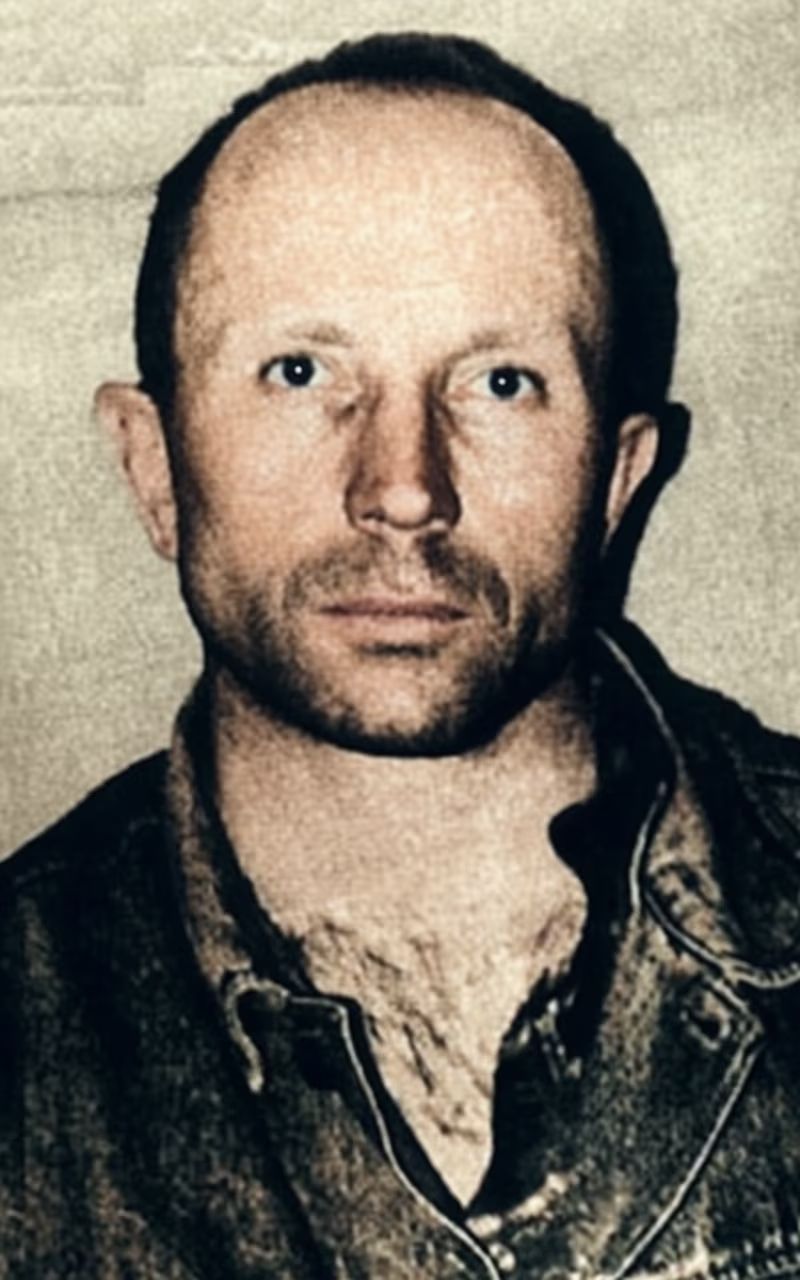

The Beast of Ukraine: Inside Anatoly Onoprienko’s 52 Victims Killing Spree
Anatoly Onoprienko serial killer cases remain among the most chilling in European crime history. The Beast of Ukraine killer story is remembered for its scale, brutality, and the terror it spread across multiple regions during the late Soviet and early post-Soviet years. Often described as one of the deadliest serial killers in Europe, Onoprienko confessed to murdering 52 people between 1989 and 1996. For readers searching for the Ukraine serial killer 52 victims case or the infamous Citizen O killer case, this is the name that appears again and again in criminal history archives.
What made his crimes especially horrifying was that he often killed entire families, including children, before setting homes on fire to destroy evidence. He moved across different areas, targeted isolated homes and roadside victims, and remained undetected for years despite a massive search effort. By the time he was finally arrested in 1996, authorities were dealing with one of the largest and most shocking murder investigations in the region.
This article of Cold Case Archive. It covers who Anatoly Onoprienko was, the timeline of his murders from 1989 to 1996, his modus operandi, the manhunt that finally ended his spree.
Who Was Anatoly Onoprienko?
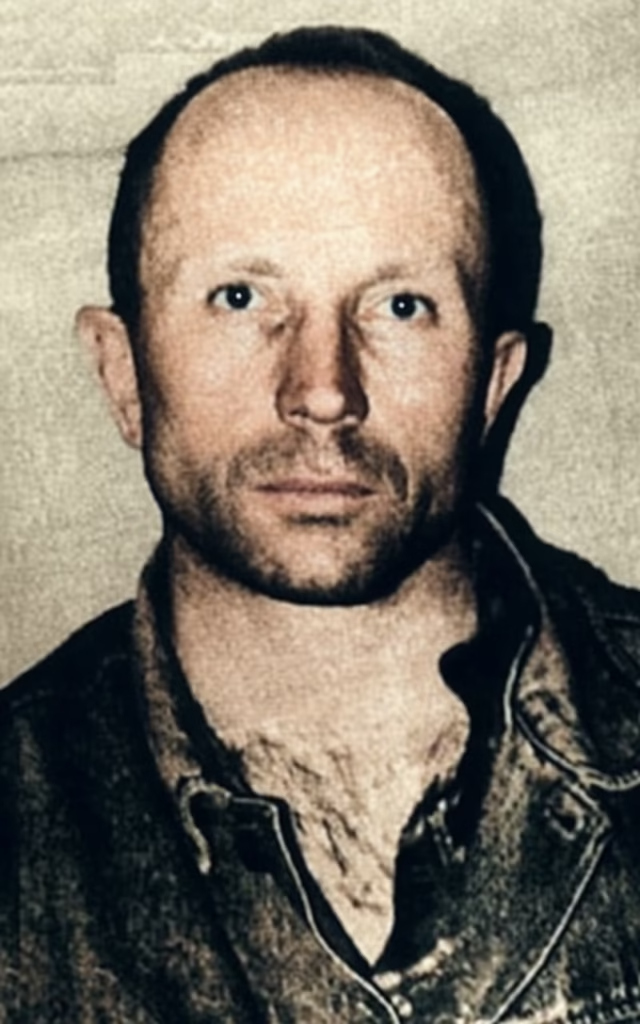
The Anatoly Onoprienko serial killer case begins in Soviet Ukraine, where he was born in 1959 in the village of Lasky, in Zhytomyr Oblast. His early life was marked by loss and instability. His mother died when he was still very young, and he later spent part of his childhood in an orphanage. According to later accounts, he deeply resented being separated from his family while his older brother remained with their father.
That early resentment became part of how he later explained himself, although nothing in his background excuses the crimes that followed. As an adult, Onoprienko worked in different roles, including time connected to maritime employment, and reportedly traveled outside Ukraine. He also had contact with law enforcement in several European countries for non-homicide offenses before his arrest in the murder case.
By the 1990s, he had become the central figure in what would be known as the Beast of Ukraine killer story. He earned several nicknames, including “The Beast of Ukraine,” “The Terminator,” and “Citizen O.” The last of these led many people to refer to the investigation as the Citizen O killer case.
His murders were not confined to one type of victim. He targeted men, women, and children. In several incidents, he entered homes and wiped out entire households. In others, he attacked travelers or bystanders who happened to cross his path. This is one reason he is still considered one of the deadliest serial killers in Europe.
Why the Citizen O Killer Case Became So Infamous
The Citizen O killer case stands out not only because of the number of deaths, but because of the fear and confusion it created. Many serial killers focus on one victim type or one geographic area. Onoprienko’s crimes were broader and harder to predict. He struck in multiple places, used more than one weapon, robbed victims, and often burned crime scenes.
For the public, the Ukraine serial killer 52 victims story was almost unimaginable. This was not a case involving a single murder or even a short series of attacks on one class of target. These crimes affected families in their homes, people on the road, and witnesses who simply had the misfortune to be nearby. The randomness increased the panic.
The Beast of Ukraine killer story also became infamous because of the challenge authorities faced in identifying him. The killings stretched over years, and the search involved huge police resources. At one point, a wrongful suspect was detained and died after being tortured, exposing major failures in the investigation. That scandal remains an important part of the case history.
When people discuss the Anatoly Onoprienko serial killer today, they often focus on two facts above all else: the extraordinary number of victims and the fact that he often killed entire families.
Early Life and Background
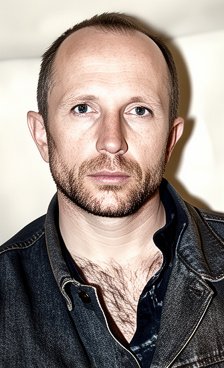
Understanding the early years of the Anatoly Onoprienko serial killer helps explain the context of the case, though not the cause. He was the younger of two brothers. His father was a war veteran, but the family did not remain stable. After his mother’s death, Anatoly’s life became fragmented between relatives and institutional care.
He later described his time in the orphanage as deeply damaging and claimed it shaped his personality and outlook. Reports also suggest he did not follow a stable educational path and may have left school before completing it. As a young adult, he reportedly worked as a sailor and sought opportunities abroad, but he did not build a settled life.
The instability continued into adulthood. He moved, drifted, and developed a pattern of disconnection from normal social structures. Long before the Beast of Ukraine killer story came to public attention, he was already living a marginal and unsettled life.
Still, many people experience hardship without becoming violent offenders. What separates Onoprienko is that he turned grievance, resentment, and criminal opportunism into a long killing spree. In the Citizen O killer case, the personal history matters only as background; the defining fact remains that he became a mass murderer responsible for 52 deaths.
Timeline of Murders (1989–1996)
One of the most important ways to understand the Ukraine serial killer 52 victims case is through the timeline of murders. The killings did not all happen in one uninterrupted burst. Instead, they unfolded across several years, with phases of murder that showed both planning and mobility.
1989: The First Confirmed Murders
Authorities linked Onoprienko to his first officially recorded murders in 1989. One of the earliest known incidents involved a family of ten killed during what was described as a robbery attempt. This alone would have been a major crime in any country. In the Anatoly Onoprienko serial killer case, it was only the beginning.
That same year, another group of five people, including a child, were shot while sleeping in a car, and their bodies were later burned. These early murders already show elements that would define the Beast of Ukraine killer story: robbery, shooting, multiple victims, and efforts to destroy evidence.
1990 to 1994: A Less Clear Period
The full sequence during the early 1990s remains less straightforward in public summaries, but investigators later believed he had committed murders before and between the most documented clusters. Onoprienko himself claimed some killings began earlier than official records initially showed.
This period contributed to the mystery of the Citizen O killer case. Law enforcement did not yet have a complete pattern, and the crimes were not fully tied together in the public mind.
Late 1995: The Murder Spree Intensifies
By late 1995, the pace and visibility of the killings sharply increased. On 24 December 1995, a family of four was murdered during a home invasion robbery. Their house was later set on fire. This became one of the most significant confirmed events in the later phase of the Ukraine serial killer 52 victims case.
January 1996: Repeated Family Murders
The violence continued into January 1996. In early January, another family of four was murdered, followed by the killing of a passerby who may have been seen as a potential witness. On 6 January, several roadside victims were murdered in separate incidents on a highway.
Then, on 17 January, another family was killed in their home. Two additional people who could have become witnesses were also murdered. This repeated pattern helped establish why the Anatoly Onoprienko serial killer is remembered as someone who often killed entire families and eliminated anyone nearby.
January to March 1996: Escalation and Final Murders
The killings continued through the following weeks. At the end of January, a woman, her two sons, and a visitor were killed. In February, another family of four was murdered inside their home. Later that same month, another household was attacked, including two young girls, and an additional nearby man was also killed.
The final confirmed murders linked to the Beast of Ukraine killer story occurred in March 1996, when yet another family of four was killed and their home was burned.
By that point, the scale of the crimes was staggering. The Citizen O killer case had become one of the largest murder investigations in the region.
Modus Operandi: How He Targeted Victims
The Anatoly Onoprienko serial killer case is especially horrifying because his modus operandi was both simple and devastatingly effective.
1. Isolated Homes
One of his most common methods was to choose a house in a more isolated area. He often preferred homes on the outskirts, where there was less chance of interruption and fewer immediate witnesses. He would create noise or force entry to draw people out or gain access.
2. Kill the Adult Male First
Investigators found that Onoprienko often began by targeting the adult male in the home. This was likely tactical. By removing the person most likely to physically resist, he reduced the chance of a struggle.
3. Move Through the Household
After that, he would move through the rest of the occupants, often attacking women and then children. This is one of the most disturbing facts in the Beast of Ukraine killer story: he repeatedly killed entire families, not just individual adults.
4. Robbery as a Secondary Objective
He often stole property, cash, clothing, jewelry, electronics, and personal items. These thefts were not always of high value, which made the crimes seem even more senseless. In some cases, he took ordinary household objects or keepsakes.
5. Burn the Scene
To remove traces, he frequently set homes or vehicles on fire. This not only destroyed evidence but also complicated early investigation efforts by masking the original sequence of events.
6. Eliminate Witnesses
Another hallmark of the Citizen O killer case was his willingness to kill random bystanders. If someone passed nearby, noticed activity, or could identify him later, they were at grave risk. This is part of why the victim count in the Ukraine serial killer 52 victims case became so high.
7. Weapons
He used a combination of weapons, including a sawed-off shotgun, knife, screwdriver, and blunt instruments. The flexibility in weapon choice made the crimes harder to neatly categorize in the early stages.
This operational pattern explains why he is remembered as one of the deadliest serial killers in Europe. He was mobile, ruthless, and willing to murder everyone present.
Why He Was So Difficult to Catch
The Citizen O killer case became a nightmare for investigators for several reasons.
First, the geography was broad. Onoprienko moved between regions, which made it harder for local police agencies to recognize one coherent pattern. Cases that might have looked linked in hindsight were not always immediately connected in real time.
Second, the victims varied. Families in homes, people in cars, roadside targets, and random witnesses did not fit a single simple profile. Many serial murder investigations benefit from a recognizable victim type. The Anatoly Onoprienko serial killer case offered less of that structure.
Third, he destroyed evidence. Burning homes and vehicles erased forensic traces and complicated timelines. In the 1990s, especially in the post-Soviet context, forensic and interagency capabilities were not always as advanced or coordinated as investigators needed.
Fourth, panic and pressure led to mistakes. The enormous public fear surrounding the Beast of Ukraine killer story increased pressure on authorities to produce results. That pressure contributed to one of the darkest failures in the case: the detention and torture of an innocent suspect.
The Wrongful Detention of Yury Mozola
A troubling chapter in the Ukraine serial killer 52 victims investigation involved Yury Mozola, who was detained as a suspect in several of the murders. During custody, he was tortured over a period of days by officials and died without confessing.
This was a major scandal. It exposed serious misconduct and showed how desperate the authorities had become while searching for the real killer. Several people involved in Mozola’s death were later sentenced.
The wrongful detention is an essential part of the Citizen O killer case history because it shows that the hunt for a serial killer can go terribly wrong when investigators abandon legal and ethical standards. It also underlined how dangerous it is to force a theory onto the wrong suspect.
Only 17 days after Mozola’s death, the real killer was found. That grim sequence remains one of the most controversial aspects of the Anatoly Onoprienko serial killer investigation.
How He Was Caught After a Massive Manhunt
The capture of Anatoly Onoprienko came after a huge search effort involving law enforcement, security services, and large-scale investigative work. Reports indicate that more than 100,000 people were involved in the broader hunt for the killer over time. That scale reflects just how much fear the Beast of Ukraine killer story had created.
Ironically, his arrest came not through a dramatic final confrontation, but through a chain of practical developments. At one point, he had been staying with relatives, and his cache of weapons and suspicious belongings created concern. He was forced to move on, and information about him began reaching the authorities.
He was eventually arrested in April 1996 at the apartment of a woman with whom he had been living. Officers found him there in a relatively ordinary domestic setting, which contrasts sharply with the scale of the crimes. A search of the apartment revealed a sawed-off shotgun and numerous items linked to victims.
This discovery was crucial. Investigators found more than a hundred objects tied to the crimes, including personal belongings taken from murder scenes. Those items helped confirm that the man they had captured was indeed at the center of the Citizen O killer case.
His arrest ended the active phase of one of the most terrifying murder sprees in the region’s history. The Anatoly Onoprienko serial killer had finally been stopped after years of violence.
Confession and Psychological Claims
After his capture, Onoprienko eventually confessed to eight killings and later admitted responsibility for 52 murders over a six-year period. He made various claims about hearing inner voices and receiving commands. During trial proceedings, he also spoke in ways that suggested grandiosity and bizarre personal theories.
However, psychiatric examination found him legally sane. This finding mattered enormously. It meant the court would treat the Beast of Ukraine killer story not as a case of a defendant unable to understand reality, but as a case involving a criminally responsible murderer.
There were later suggestions that elements of his courtroom presentation may have been encouraged or amplified by defense strategy to make him appear unstable. But the final legal conclusion was clear enough: he was fit to stand trial and responsible for his actions.
This legal determination is one reason the Citizen O killer case remains so significant. Despite bizarre claims, the system concluded that the offender knew what he was doing.
Trial, Sentence & Death
The trial of the Anatoly Onoprienko serial killer was one of the most closely watched criminal proceedings in Ukraine at the time. By then, he had admitted to 52 murders, and the public already understood the scale of the horror.
He was convicted of murder on 52 counts. Initially, he was sentenced to death. However, the sentence was later commuted to life imprisonment as Ukraine moved away from capital punishment under its obligations connected to European legal standards.
That outcome meant the Ukraine serial killer 52 victims case ended not with execution, but with life imprisonment. He was held in prison in Zhytomyr, where he remained for the rest of his life.
Onoprienko died in prison on 27 August 2013 at the age of 54.
For many people, the end of the Citizen O killer case was unsatisfying simply because no sentence could match the scale of the losses. But the legal process did at least ensure that one of the most notorious mass murderers in modern European history would spend the remainder of his life behind bars.
Why Anatoly Onoprienko Is Considered One of the Deadliest Serial Killers in Europe
There are many notorious names in international true crime, but the Anatoly Onoprienko serial killer stands out because of the sheer number of victims. With 52 confessed murders, he is widely regarded as one of the deadliest serial killers in Europe.
Several features make his case especially severe:
- He murdered over multiple years.
- He attacked adults and children.
- He often killed entire families.
- He destroyed property and evidence.
- He murdered witnesses as well as primary targets.
- He kept moving, making the investigation much harder.
The Beast of Ukraine killer story is therefore not just another serial killer profile. It is a case involving family annihilation, robbery, arson, and repeated mass killings. Few European cases combine those elements on such a scale.
Legacy of the Citizen O Killer Case
The legacy of the Citizen O killer case is complex and troubling.
On one hand, it remains a major case study in serial murder, criminal mobility, and investigative coordination across regions. It is studied because it demonstrates how a determined offender can exploit gaps in policing, especially during periods of political and institutional transition.
On the other hand, it is also remembered for investigative failure. The wrongful detention and death of Yury Mozola remain a stain on the case. That tragedy shows how fear and pressure can lead authorities into catastrophic mistakes.
For the public, the Ukraine serial killer 52 victims case remains unforgettable because of the scale of suffering involved. Entire households were erased. Children were among the victims. Survivors and relatives were left with trauma that could never be repaired.
The Anatoly Onoprienko serial killer is remembered not because of who he was as a person, but because of the devastating absence left behind by the people he murdered.
Final Thoughts
The Anatoly Onoprienko serial killer case remains one of the most horrifying criminal stories in postwar Europe. The Beast of Ukraine killer story combines mass murder, robbery, arson, and the repeated destruction of families. With 52 confessed victims, he remains one of the deadliest serial killers in Europe, and the Citizen O killer case continues to be cited whenever experts discuss extreme serial violence.
His crimes from 1989 to 1996 followed a grim pattern: isolated homes, sudden attacks, the murder of all occupants, theft of property, and destruction of evidence by fire. He also killed random witnesses, which pushed the victim count even higher. Again and again, he killed entire families, making the case particularly devastating.
The manhunt that ended with his arrest in April 1996 closed one of the darkest chapters in Ukrainian criminal history. His later conviction, life sentence, and death in prison brought legal closure, but not emotional closure for the families affected.
For readers of Cold Case Archive, the Ukraine serial killer 52 victims case is a stark reminder of how devastating one offender can be when violence, mobility, and opportunity intersect. It also shows the importance of careful investigation, lawful policing, and historical accuracy when covering some of the worst crimes ever committed.
FAQ
Who was Anatoly Onoprienko?
Anatoly Onoprienko was a Soviet and Ukrainian serial killer and mass murderer who confessed to killing 52 people between 1989 and 1996.
Why was he called the Beast of Ukraine?
He earned the nickname because of the scale and brutality of his crimes, especially the fact that he often killed entire families.
How many people did Anatoly Onoprienko kill?
He confessed to 52 murders, which is why many people search for the Ukraine serial killer 52 victims case.
What was the Citizen O killer case?
The Citizen O killer case is another name associated with Anatoly Onoprienko and the investigation into his murders.
How was Anatoly Onoprienko caught?
He was arrested in April 1996 after a massive manhunt. Investigators found weapons and items belonging to victims at the apartment where he was staying.
What sentence did he receive?
He was initially sentenced to death, but the punishment was commuted to life imprisonment. He died in prison in 2013.
Disclaimer
The content presented in this article is based on publicly available information and is intended for informational and educational purposes only. While every effort has been made to ensure accuracy, details surrounding ongoing or unsolved cases may change over time as new information becomes available.
This article does not intend to make accusations, assign guilt, or interfere with any active investigation. Any individuals mentioned are presumed innocent unless proven guilty in a court of law.
The views and interpretations expressed are those of the writer and do not represent official statements from law enforcement agencies or affiliated organizations.
This content may include sensitive topics related to crime and violence. Reader discretion is advised.
If you have any information related to this case, please contact the appropriate local authorities.
Case Source:
This case information was compiled from publicly available sources, including official records, news reports, and case archive websites such as zhzh.info. This article is intended for informational and educational purposes only, and all information is based on sources believed to be accurate at the time of writing.