





The Window Vampire: Did Florencio Fernández Really Kill 15 Victims?
Florencio Fernández: The Argentine Vampire Serial Killer or Myth?
The florencio fernandez serial killer case remains one of the most unsettling and debated stories in Latin American crime folklore. Often described as the argentine vampire killer story, the tale of Florencio Roque Fernández has circulated for decades as one of Argentina’s strangest alleged murder cases. Depending on which version is told, he was either a deeply disturbed man responsible for a string of terrifying nighttime attacks, or the center of an exaggerated legend shaped by fear, gossip, and sensational reporting.
The case is most often tied to Monteros, Argentina, where residents reportedly lived in fear during the 1950s. According to popular retellings, Fernández entered homes through windows, attacked sleeping women at night, and left behind injuries that gave rise to the nickname “window vampire argentina case.” Some accounts claim as many as 15 alleged victims, which is why the case is also linked to the phrase monteros vampire murders. But despite how often the story appears in crime lists and dark-history discussions, one big question remains:
Was Florencio Fernández a real serial killer, or is the Argentine Vampire mostly an urban legend?
That mystery is exactly why the story still fascinates readers today. The alleged crimes combine elements of true crime, folklore, mental illness, public panic, and media mythmaking. The result is a case that sits in a gray area between history and horror.
In many versions of the story, the central figure is identified as Florencio Roque Fernández, a troubled man from rural Argentina whose life allegedly spiraled into violence. He is said to have believed he was a vampire, hidden in caves, attacked by night, and terrified an entire community before being captured and declared mentally unfit for trial. Yet researchers who try to verify the details often run into a frustrating problem: official documentation is scarce, and many of the most dramatic claims are difficult to confirm.
That is why the florencio fernandez serial killer story remains so controversial. It may contain a core of truth, but it also bears many signs of folklore expansion. In this article, we’ll explore the known claims, the psychological angle, the alleged crimes, the investigation, and the strongest arguments for why the case may be partly — or largely — myth.

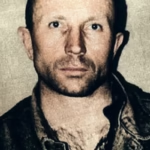
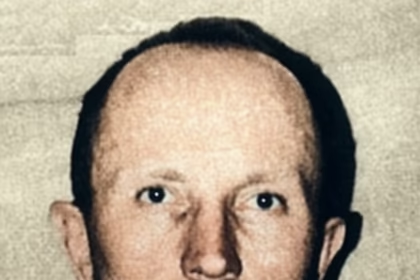
The only possible photo that exists of Florencio Fernández (Archive). Re created by Ai
Brief Overview of the Case
The argentine vampire killer story is usually placed in Argentina, specifically in the town of Monteros in Tucumán Province. The story claims that during the 1950s, a man named Florencio Roque Fernández carried out a series of nighttime attacks that led to around 15 alleged victims. These attacks were said to involve sneaking into homes through open windows, preying on women, and leaving behind marks that encouraged rumors of blood drinking and vampirism.
As the fear spread, the town reportedly entered a state of panic. Doors and windows were more tightly secured, neighbors grew suspicious of unusual movement at night, and stories circulated that a real-life vampire was stalking Monteros. Eventually, police allegedly located Fernández in a cave and arrested him in 1960. He was then declared mentally unfit, diagnosed with schizophrenia, and confined to a psychiatric institution. He reportedly died in 1968 of natural causes.
That is the “official” shape of the story as it is often repeated online. But the lack of complete records makes it difficult to know how much is firmly documented and how much has been added over time.
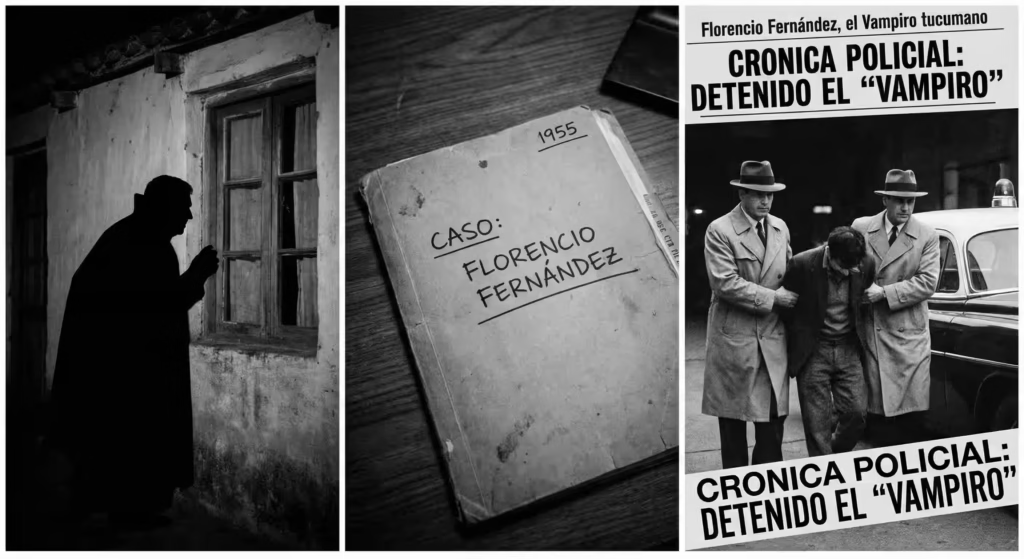
Who Was Florencio Fernández?
The story of the florencio fernandez serial killer usually begins with his birth in 1935 in Monteros, Argentina. He is often described as someone who came from severe poverty and instability, conditions that may have contributed to both his isolation and his deteriorating mental condition later in life.
Birth and Early Life
If the common narrative is accurate, Florencio Roque Fernández was born into difficult circumstances in rural Tucumán. Many versions of the case suggest he experienced a harsh childhood marked by neglect, deprivation, and social exclusion. These details are important because they often form the foundation for later interpretations of his behavior.
Monteros in the mid-20th century was not the kind of place where psychological distress would necessarily be diagnosed early or treated effectively. In poor communities, especially at that time, mental illness was often misunderstood, hidden, or explained through superstition.
Childhood Struggles
Accounts of Fernández’s youth often describe him as troubled from an early age. Some stories claim he had difficulty relating to others, behaved erratically, or showed signs of psychological disturbance long before the alleged crimes. However, because reliable records are limited, these details should be treated cautiously.
Still, whether every detail is factual or not, the argentine vampire killer story consistently presents Fernández as a marginalized figure — someone on the edge of society, vulnerable to delusion and removed from normal community life.
Abandonment and Street Life
One recurring theme in the story is abandonment. Fernández is often portrayed as someone who drifted through street life, cut off from stable family support and living in rough conditions. That image helps explain why later accounts place him in caves or isolated hiding places.
This part of the story matters because it contributes to the larger mythic image: not just a suspected killer, but a wild, nocturnal outsider living beyond the boundaries of ordinary society.
Mental Health Issues
A major part of the case involves claims that Fernández suffered from schizophrenia. This diagnosis appears in many retellings and is central to understanding why authorities allegedly considered him mentally unfit rather than fully criminally responsible.
It is essential to discuss this carefully. Mental illness alone does not make someone violent, and most people with schizophrenia are not dangerous. In this case, however, the diagnosis is often used to explain severe delusions and bizarre behavior attributed to Fernández.
Psychological Profile
The psychological dimension is one reason the window vampire argentina case continues to attract attention. The alleged belief that he was a vampire transformed the case from a local crime story into something much larger and more sensational.
Delusions of Being a Vampire
According to the most repeated versions, Florencio Fernández believed he was a vampire or had vampire-like needs. This belief allegedly influenced the way he selected victims and carried out attacks. Whether literal or symbolic, the vampire identity became the defining element of the case.
This is also why the story is so often retold in a dramatic way. The image of a man convinced he was a blood-drinking predator is more memorable than an ordinary criminal profile, and that makes exaggeration more likely over time.
Influence of Dracula Stories
Some versions suggest that Fernández was influenced by Dracula stories or popular vampire imagery. If true, this would fit a pattern seen in some disturbed offenders who absorb fictional ideas into delusional thinking. But again, evidence for this is not always clear.
Even so, the connection between horror fiction and public fear likely played a role in how the story spread. Once the word “vampire” became attached to the case, the community’s imagination may have done the rest.
Possible Renfield Syndrome
Modern discussions sometimes mention Renfield syndrome, an unofficial term occasionally used to describe pathological fascination with drinking blood. It is not a formal standalone diagnosis in major psychiatric manuals, but it is often brought up in unusual crime discussions involving vampiric behavior.
Applying that label to Fernández may be speculative, but it helps explain why later writers linked his alleged actions with a blood obsession.
Behavior Patterns
The behavior pattern described in the monteros vampire murders story is consistent across many retellings:
- He allegedly moved at night
- Chose vulnerable victims
- Avoided direct confrontation with large groups
- Entered quietly and unexpectedly
- Inspired fear far beyond the physical evidence of any individual attack
These are the patterns that created the image of a lurking predator rather than a conventional criminal.
Modus Operandi: How the Crimes Were Allegedly Committed
The window vampire argentina case gets its name from the specific way Fernández was said to approach victims.
Entering Homes Through Windows
The most repeated claim is that he entered homes through windows, especially at night when victims were asleep or least alert. That detail is crucial because it intensified fear in Monteros. A locked door can feel protective; an open or vulnerable window feels much more unsettling.
The phrase window vampire argentina case survives precisely because this image became central to the legend.
Attacking Victims at Night
Nighttime attacks are another major feature of the story. According to local accounts, Fernández was believed to move under cover of darkness, appearing silently and disappearing before residents could react. Whether these reports were fully accurate or partly shaped by rumor, they contributed to a climate of fear.
Biting the Neck and Draining Blood
This is the most controversial and sensational part of the argentine vampire killer story. Some versions claim he bit victims on the neck and attempted to drink blood. Others are more cautious and say the injuries were interpreted that way by frightened locals and sensationalized media coverage.
Because surviving documentation is weak, this detail cannot be confirmed with certainty. It is possible that unusual wounds, panic, and folklore merged into the vampire narrative.
Targeting Women
Most versions of the case say Fernández primarily targeted women. That element appears repeatedly in retellings of the monteros vampire murders and helps explain why fear spread especially quickly among households in the area.
Again, however, identifying the alleged victims is one of the major weaknesses in the story’s documentary basis.
Fear in Monteros
The florencio fernandez serial killer legend is as much about public terror as it is about the alleged offender himself.
Community Panic
As rumors spread, Monteros reportedly became gripped by panic. Residents feared staying near open windows at night, and unusual sounds were interpreted as possible signs that the “vampire” was nearby.
People Locking Homes
One common feature of the story is that families began securing homes more carefully, especially windows and shutters. Whether prompted by actual attacks or rumor, this kind of defensive behavior is typical in communities facing an unknown threat.
Spread of Vampire Rumors
Once the vampire explanation took hold, fear likely amplified every new story. In small communities, a single frightening incident can become many stories by the next day. Details grow sharper, victims multiply in rumor, and ordinary criminal behavior can be transformed into something supernatural.
Cultural Impact
This is why the argentine vampire killer story endured. It wasn’t just about one man. It became part of local cultural memory — a story repeated because it reflected anxieties about night, madness, vulnerability, and unseen danger.
Investigation and Arrest
The alleged capture of Florencio Fernández is one of the strongest repeated elements in the story.
Police Involvement
As fear in Monteros increased, police reportedly began investigating the incidents more seriously. The community pressure would have been intense if multiple attacks were being attributed to the same figure.
Surveillance and Suspicion
Some versions say law enforcement increased surveillance in areas where sightings or attacks had been reported. Suspicion reportedly centered on Fernández because of his strange behavior, appearance, and possible connection to isolated areas around town.
Arrest in a Cave in 1960
The most dramatic detail is that Florencio Roque Fernández was arrested in a cave in 1960. This image has become inseparable from the legend: the “vampire” hiding like an animal or monster on the outskirts of society.
Even if the cave arrest did happen, the way it has been retold over time likely increased its theatrical quality.
Conditions He Lived In
Stories often describe filthy, primitive, or isolated living conditions. These descriptions reinforce the image of Fernández as feral and disconnected from normal human life. Such details may contain truth, but they also fit neatly into myth-building.
Trial and Psychiatric Evaluation
After his arrest, the story says Fernández did not face an ordinary criminal path.
Declared Mentally Unfit
According to repeated accounts, authorities determined that he was not mentally competent to stand trial in the usual sense. That conclusion aligns with the idea that he suffered from severe delusions.
Diagnosed with Schizophrenia
The diagnosis most often attached to him is schizophrenia. This is presented as the explanation for his distorted beliefs, strange conduct, and inability to understand reality in a stable way.
Sent to a Psychiatric Hospital
Rather than a standard prison sentence, he was reportedly committed to a psychiatric institution. This part of the story gives it an “official ending,” even though documentation surrounding the case remains incomplete.
Death of Florencio Fernández
The standard version of the story says that Fernández died in 1968.
Died in 1968
Most retellings agree on this year, though further records are hard to verify.
Natural Causes
He is commonly said to have died of natural causes while institutionalized.
End of Official Story
If that account is true, then the official life story of the alleged florencio fernandez serial killer ends not with execution or dramatic confrontation, but with a quiet death in custody or care.
Was the Case Real or a Myth?
This is the most important part of the entire window vampire argentina case, because this is where the story becomes far more complicated.
Lack of Official Records
Researchers looking for hard evidence often discover that the case is difficult to document in a solid way. There are references, repeated summaries, and oral retellings, but fewer verifiable official records than one might expect for a serial murder case involving 15 victims.
That is a serious issue. If the monteros vampire murders truly involved that many victims, stronger archival evidence would normally be expected.
No Confirmed Victim Identities
One of the biggest problems is the absence of clearly confirmed victim lists. A serial killer case with approximately 15 victims should leave behind names, dates, and local reporting. Yet in many versions of this case, those details remain vague.
That does not automatically prove the story is false. Older regional cases can suffer from poor record preservation. But it does weaken certainty.
Missing Documentation
Another issue is inconsistent documentation. Details like exact attack dates, police files, court records, and institutional paperwork are often missing from retellings. In true crime research, gaps like these matter.
Possibility of Urban Legend
Because of all these weaknesses, many people suspect that the argentine vampire killer story may be an urban legend built around a real person, a real mental health case, or perhaps one or two genuine assaults that later grew into a larger narrative.
That is often how legends form:
- A disturbing real event happens
- Rumors spread quickly
- The media or locals add dramatic interpretations
- Repetition turns uncertainty into “fact”
Analysis: Truth vs. Legend
So what is the most balanced view of the florencio fernandez serial killer case?
There May Be a Real Core
It is entirely possible that Florencio Roque Fernández was a real individual from Monteros who suffered from severe mental illness and became associated with violent or alarming behavior. The persistence of the story suggests there may be a historical core.
The Victim Count May Be Exaggerated
The figure of 15 alleged victims may reflect fear more than confirmed fact. In public memory, numbers often expand, especially when a case becomes infamous.
The Vampire Label Was Powerful
Calling someone a vampire changes how people process events. It adds drama, fear, and symbolism. Once that label appeared, every rumor could be folded into the same terrifying narrative.
Media Exaggeration Is Likely
Sensational stories survive because they are repeated. The more bizarre the story, the more likely it is to be republished, dramatized, and simplified. The window vampire argentina case has all the ingredients for that process.
Fear-Driven Narratives Shape Memory
Communities under stress often create stories that explain danger in vivid terms. A mysterious attacker becomes a monster. A disturbed drifter becomes a supernatural predator. This doesn’t mean nothing happened — only that fear can reshape the memory of what happened.
Best Conclusion
The strongest evidence-based conclusion is this:
The Florencio Fernández story may be rooted in a real individual and real local fear, but many of the most dramatic details remain disputed and may belong more to folklore than fully documented criminal history.
That is exactly why the case is so compelling. It exists at the intersection of crime, psychology, and myth.
Key Facts Summary
- Name: Florencio Roque Fernández
- Nickname: The Argentine Vampire
- Location: Monteros, Argentina
- Birth: 1935
- Years active: 1950s
- Alleged victims: Approximately 15
- Behavior: Allegedly entered homes through windows at night
- Target group: Women
- Psychological factor: Reported schizophrenia and vampire delusions
- Arrest: Allegedly captured in a cave in 1960
- Legal outcome: Declared mentally unfit
- Institutionalization: Sent to psychiatric care
- Death: 1968
- Status of case: Disputed / partly undocumented / possible urban legend
Why the Story Still Matters
The monteros vampire murders remain important not just because of their shock value, but because they raise larger questions about how crime stories are created, preserved, and distorted. When records are incomplete, communities fill the gaps. When fear is intense, explanation becomes symbolic. And when a case includes unusual behavior, mental illness, and alleged blood-related violence, it almost inevitably becomes legend.
For readers of historical crime, the florencio fernandez serial killer case is a reminder to be cautious. Not every famous story is fully false, but not every repeated detail is reliable either. Some cases demand skepticism and curiosity at the same time.
That is what makes Florencio Fernández so unforgettable. He may have been a dangerous and deeply disturbed man. He may have been transformed by rumor into something more monstrous than reality. Or both may be true at once.
In the end, the argentine vampire killer story survives because it refuses to sit neatly in one category. It is part true crime, part psychological mystery, and part urban legend — which may be exactly why people still search for answers decades later.
FAQs
Who was Florencio Fernández?
Florencio Fernández, often identified as Florencio Roque Fernández, was a man from Monteros, Argentina, who is linked to the legend of the Argentine Vampire. He was reportedly accused of a series of nighttime attacks in the 1950s.
Was Florencio Fernández a real serial killer?
The answer is disputed. The florencio fernandez serial killer story may be based on a real person and real incidents, but much of the case lacks strong documentation, making it difficult to confirm every claim.
Why is he called the Argentine Vampire?
He was given that nickname because stories claimed he attacked victims at night, entered through windows, and bit the necks of women, leading to the argentine vampire killer story label.
What is the window vampire Argentina case?
The window vampire argentina case refers to the alleged pattern of entering homes through windows during nighttime attacks in Monteros.
How many victims were there?
Most retellings mention around 15 alleged victims, but confirmed identities and records are limited.
Was Florencio Fernández mentally ill?
According to repeated accounts, he was diagnosed with schizophrenia and declared mentally unfit, though surviving official documentation is sparse.
Was he arrested?
Yes, the common version of the story says he was arrested in 1960, allegedly while hiding in a cave near Monteros.
How did Florencio Fernández die?
Most versions state that he died in 1968 of natural causes after being placed in psychiatric care.
Are the Monteros vampire murders fully documented?
No. The monteros vampire murders are widely discussed, but the documentary record appears incomplete, which is why many researchers question how much of the case is historical fact and how much is legend.
Disclaimer
The content presented in this article is based on publicly available information and is intended for informational and educational purposes only. While every effort has been made to ensure accuracy, details surrounding ongoing or unsolved cases may change over time as new information becomes available.
This article does not intend to make accusations, assign guilt, or interfere with any active investigation. Any individuals mentioned are presumed innocent unless proven guilty in a court of law.
The views and interpretations expressed are those of the writer and do not represent official statements from law enforcement agencies or affiliated organizations.
This content may include sensitive topics related to crime and violence. Reader discretion is advised.
If you have any information related to this case, please contact the appropriate local authorities.
Case Source:
This case information was compiled from publicly available sources, including official records, news reports, and case archive websites such as cronica. This article is intended for informational and educational purposes only, and all information is based on sources believed to be accurate at the time of writing.