



By Cold Case Archive Investigative Team
Published: April 2026
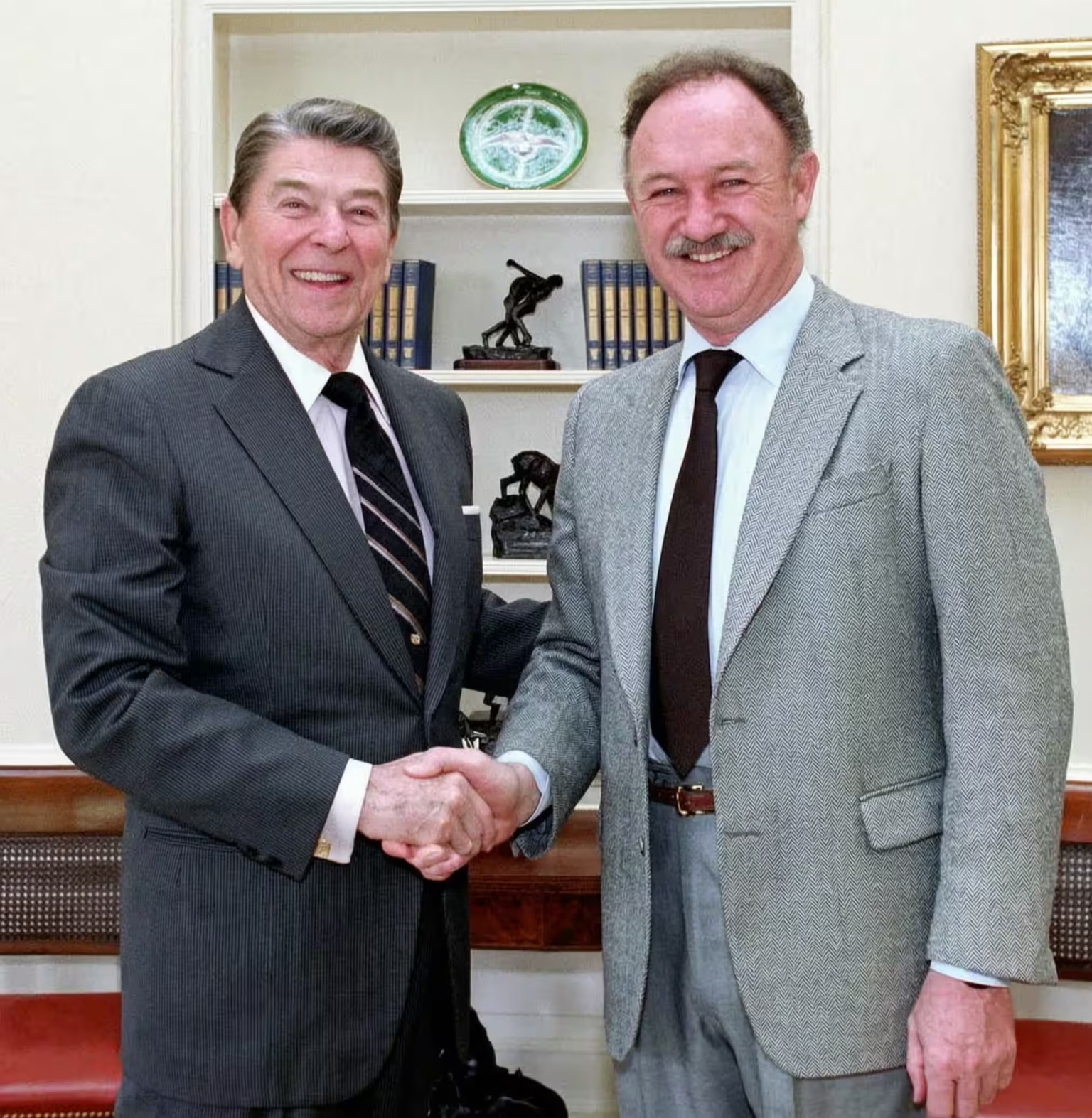
For weeks in early 2025, the world held its breath. The bodies of one of Hollywood’s greatest actors, Gene Hackman, and his classical pianist wife, Betsy Arakawa, had been found in their Santa Fe, New Mexico, home under circumstances so bizarre that even veteran investigators hesitated to draw conclusions.
No forced entry. No visible wounds. But also: no carbon monoxide. No obvious cause. And one of their dogs lay dead beside them.
The Gene Hackman Death Mystery Solved would eventually become a tragic lesson in medical rarity, the cruelty of Alzheimer’s disease, and an agonizing final week that no one — least of all Hackman himself — could have prevented. This investigative report pieces together the full timeline, the medical findings, and the quiet horror of what really happened inside that hilltop house.
Part One: The Discovery That Shocked Hollywood
February 26, 2025 – A Routine Maintenance Call Turns Horrific
The gated community on Old Sunset Trail in Santa Fe is known for privacy. Its residents include artists, writers, and retirees who value seclusion above all else. When maintenance workers arrived at the Hackman-Arakawa home on the morning of February 26, 2025, nothing seemed immediately amiss.
But no one answered the door.
According to Santa Fe County Sheriff’s Office reports obtained by Cold Case Archive, workers forced entry shortly after 1:30 PM. What they found would trigger one of the most intensely scrutinized death investigations in modern celebrity history.
Eugene Allen Hackman — two-time Academy Award winner, star of The French Connection, Unforgiven, and Superman — lay motionless in the mudroom near the kitchen. His body showed no signs of struggle. Beside him, a space heater had been knocked over, but there was no fire. His wife, Betsy Arakawa, 65, was found in a bathroom, an open prescription bottle and scattered pills nearby. A third victim: one of their three dogs, dead in a crate.
The other two dogs were found alive elsewhere in the house.
Initial reports described the scene as “suspicious.” Sheriff Adan Mendoza told reporters, “There was no immediate indication of foul play, but the circumstances warranted a full investigation.”
The Gene Hackman solved case was far from solved that day. It was just beginning.
In the weeks following the shocking discovery, the Gene Hackman Death Mystery Solved became a topic of conversation across the nation.
Part Two: The Actor Who Became a Legend
To understand the weight of this loss, one must first understand the man.
From San Bernardino to Stardom
Eugene Allen Hackman was born January 30, 1930, in San Bernardino, California. His childhood was restless. His father, a newspaper press operator, left the family when Gene was 13. By 16, he had lied about his age to enlist in the U.S. Marine Corps, serving four and a half years as a field radio operator in China, Hawaii, and Japan.
After his discharge, Hackman drifted. He studied journalism under the G.I. Bill but left without graduating. He worked as a doorman, a truck driver, a janitor. And all the while, he nursed a secret ambition he had held since age ten, when he first saw James Cagney on screen: he wanted to act.
The Pasadena Playhouse Years
At the Pasadena Playhouse in California, Hackman befriended another struggling actor named Dustin Hoffman. Neither fit the mold. Both were voted “least likely to succeed” by their classmates. Hackman received the lowest score the Playhouse had ever given.
He later recalled a former instructor seeing him working at a Howard Johnson’s restaurant and smugly remarking that the job proved Hackman “wouldn’t amount to anything.”
“I wasn’t going to let those fuckers get me down,” Hackman said years later. And he didn’t.
Hollywood’s Everyman Antihero
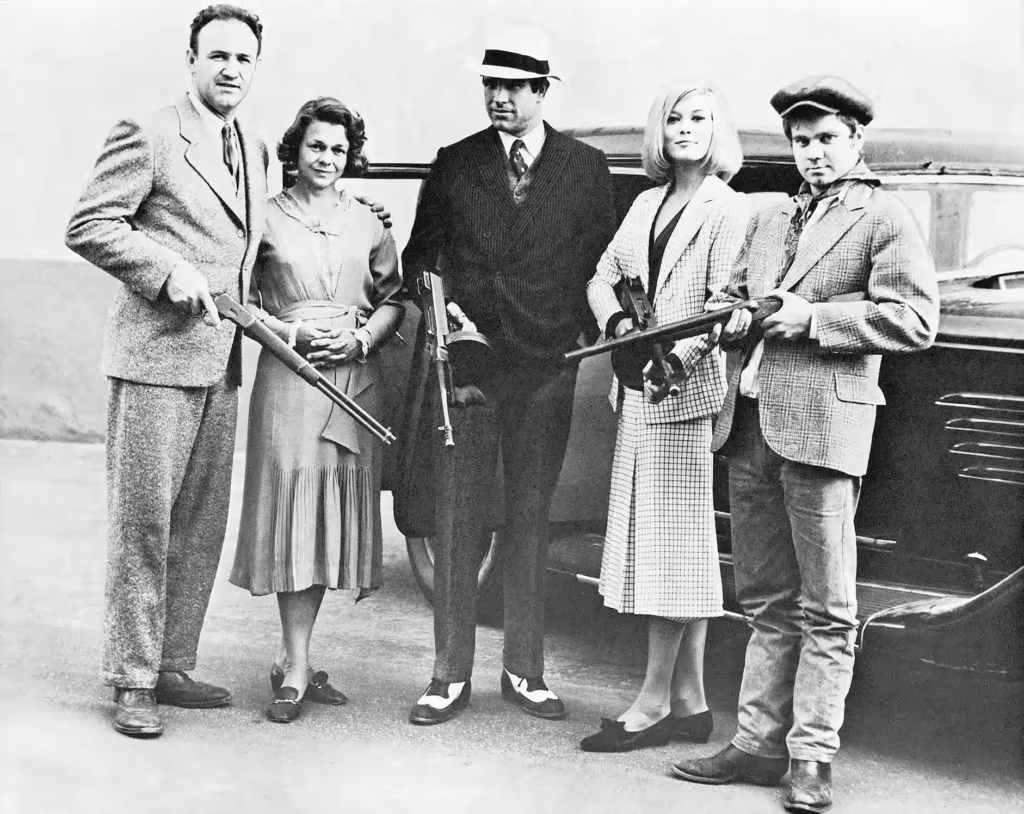
Hackman’s breakthrough came with Bonnie and Clyde (1967), earning his first Oscar nomination. But it was The French Connection (1971) that made him a star. His portrayal of Detective Jimmy “Popeye” Doyle — tired, mean, obsessive — won him the Academy Award for Best Actor.
He followed with an astonishing run: The Poseidon Adventure (1972), Scarecrow (1973), The Conversation (1974), Young Frankenstein (1974), Night Moves (1975). He played Lex Luthor opposite Christopher Reeve’s Superman. He won a second Oscar as the sadistic sheriff “Little Bill” Daggett in Clint Eastwood’s Unforgiven (1992).
By the time he retired after Welcome to Mooseport (2004), Hackman had appeared in over 80 films. He was widely regarded as one of the greatest actors of his generation — a paragon of the New Hollywood movement that had redefined American cinema.
But in retirement, Hackman wanted only one thing: quiet.
Part Three: A Quiet Life in the High Desert
Marriage to Betsy Arakawa
On December 1, 1991, Hackman married classical pianist Betsy Arakawa. They had dated for seven years. She was 32; he was 61. The age difference raised eyebrows, but those who knew them described a genuine partnership.
Arakawa was born in Hawaii in 1959, the daughter of a Japanese-American father and a Caucasian mother. She studied piano at the University of Southern California and later performed with chamber orchestras. She was private, intelligent, and fiercely protective of Hackman’s peace.
Together, they built a home in Santa Fe, New Mexico — a 12-acre hilltop property with 360-degree views of the Jemez, Sangre de Cristo, and Sandia mountains. Architectural Digest featured the home in 1990, praising its blend of Southwestern styles and its serene, meditative quality.
Friends said Hackman had finally found the stability that had eluded him in childhood. He cycled daily. He wrote novels. He watched Jacksonville Jaguars games. And he stayed far, far away from Hollywood.
The Final Months
In late 2024, neighbors noticed a change. Hackman, then 94, appeared frailer. He and Arakawa began to withdraw from social contact. Phone calls to family went unreturned. Holiday greetings never came.
What no one outside the home knew was that Hackman’s health was declining rapidly. He had been diagnosed with Alzheimer’s disease — a progressive neurological disorder that erodes memory, reasoning, and eventually the ability to perform basic tasks.
Arakawa became his sole caregiver. She managed his medications, his meals, his appointments. It was a role she accepted without complaint, but it isolated them both.
Part Four: The Medical Mystery Unfolds
February 11, 2025 – The Last Sighting
On February 11, 2025, Betsy Arakawa was seen alive for the last time. Security footage from a CVS Pharmacy in Santa Fe showed her purchasing over-the-counter items. She appeared tired but otherwise normal. She returned to the gated community at 5:15 PM.
The next day, February 12, Arakawa telephoned a private physician. According to investigative records, she complained of respiratory problems — shortness of breath, fatigue, a persistent cough. She made an appointment for that afternoon.
She never arrived.
What Is Hantavirus Pulmonary Syndrome?
The Gene Hackman solved case ultimately turned on a pathogen so rare that most people have never heard of it. Hantavirus pulmonary syndrome (HPS) is a severe, sometimes fatal respiratory disease caused by hantaviruses. Humans contract it primarily through exposure to rodent droppings, urine, or saliva — most commonly from deer mice.
Initial symptoms mimic the flu: fatigue, fever, muscle aches. But within days, the disease attacks the lungs, causing fluid buildup and respiratory failure. There is no specific cure. Treatment is supportive — oxygen, intubation, intensive care. Even with aggressive treatment, mortality rates range from 30% to 50%.
In New Mexico, where deer mice are common in rural and semi-rural areas, sporadic cases occur every year. But it is extraordinarily rare. The state typically reports fewer than ten cases annually.
Arakawa likely inhaled aerosolized virus particles while cleaning an area of the home where rodents had been present — perhaps a shed, a garage, or a rarely used closet. Within days, her lungs began to fill with fluid.
She died in the bathroom of her own home, probably on February 12 or early February 13.
Why Didn’t She Go to the Hospital?
Investigators believe Arakawa underestimated the severity of her symptoms. By the time she realized she needed help, she may have been too weak to drive or call for assistance. Her phone records show no outgoing calls after February 12.
She died alone, in the house she shared with a husband who, because of his advancing Alzheimer’s, could no longer fully comprehend what was happening.
Part Five: The Unspeakable Week
February 13 – 18, 2025 – Living with the Body
This is the detail that haunts the Gene Hackman solved case.
After Arakawa died, Gene Hackman continued to move through the house for approximately one week. He ate. He drank water. He used the bathroom. He may have even let the two surviving dogs in and out.
But he did not call for help. He did not notify family. He did not appear to understand that his wife of 34 years was dead.
The autopsy later revealed the reason: advanced Alzheimer’s disease.
According to the Office of the Medical Investigator, Hackman’s Alzheimer’s had progressed to the point where he could no longer recognize death. He may have seen Arakawa’s body and registered it as a person sleeping. Or he may not have registered it at all. The disease had eroded his ability to form new memories or process unexpected situations.
For seven days — perhaps longer — the 95-year-old actor lived alongside the body of his dead wife. He likely talked to her. He may have brought her food. He was, in the most tragic sense, going through the motions of a life that had already ended.
February 18, 2025 – Hackman’s Final Day
On or around February 18, Hackman’s pacemaker recorded an abnormal cardiac rhythm. He had suffered from heart disease for years, including a previous angioplasty in 1990. The medical examiner’s report would later list the official cause of death as severe heart disease, complicated by advanced Alzheimer’s disease and kidney disease.
He died in the mudroom near the kitchen. A space heater had been knocked over, but there was no fire. It is possible he stumbled, or that the heater fell as he collapsed. No one will ever know for certain.
One of the three dogs — a beloved pet — died in a crate. Investigators believe the dog may have been trapped without food or water after Arakawa’s death. The other two dogs, which had access to the house and perhaps to spilled food or water, survived.
Part Six: The Investigation
February 26, 2025 – Bodies Found
When maintenance workers finally entered the home, they found a scene that defied easy explanation. Two bodies. One dead dog. Two live dogs. No obvious cause of death. No suicide note. No forced entry.
The Santa Fe County Sheriff’s Office launched a full investigation. Early reports emphasized the word “suspicious.”
Sheriff Adan Mendoza held a press conference within 24 hours. “We are not ruling anything out at this time,” he said. “We are awaiting toxicology and autopsy results.”
Social media erupted with theories. Had there been a murder-suicide? A carbon monoxide leak? An accidental overdose? A double suicide pact?
For weeks, the public knew only that two beloved figures had died under strange circumstances. The Gene Hackman solved case was still anything but solved.
The Autopsy Results
On March 15, 2025, the Office of the Medical Investigator released its findings. The results were startling not for their complexity, but for their tragic simplicity.
- Betsy Arakawa: Died of hantavirus pulmonary syndrome. Death was natural. Estimated time of death: February 12 or 13.
- Gene Hackman: Died of severe heart disease (atherosclerotic cardiovascular disease), with advanced Alzheimer’s disease and kidney disease as contributing factors. Estimated time of death: approximately February 18.
- The dog: Died of dehydration and starvation, consistent with being confined to a crate for several days.
No foul play. No carbon monoxide. No murder.
Why Was the Dog in a Crate?
One lingering question: why was one dog crated while the other two roamed free? Investigators concluded that Arakawa had likely placed the dog in its crate — a routine practice — shortly before she fell fatally ill. With no one to release it, the animal perished.
It is a small detail, but it speaks to the larger tragedy: a household where one sudden, unexpected death triggered a cascade of secondary losses.
Part Seven: The Role of Alzheimer’s Disease
A Cruel Thief
The Gene Hackman solved case cannot be understood without confronting the reality of Alzheimer’s disease. It is not simply memory loss. It is a progressive, fatal brain disorder that slowly destroys cognitive function.
In its advanced stages, patients lose the ability to:
- Recognize familiar faces (including spouses)
- Understand time and place
- Perform basic self-care
- Respond to emergencies
Hackman had been diagnosed years earlier, though the information was kept private. Friends later recalled noticing his withdrawal from social events. His last public appearance was in March 2024, nearly a year before his death.
Could Hackman Have Saved His Wife?
This is the question that torments fans and family alike. If Hackman had been healthy, he would have called 911 the moment he found Arakawa unresponsive. He would have attempted CPR. He would have summoned help.
But his Alzheimer’s had progressed to the point where he could not. He did not understand that she was dead. He did not understand that he was in danger. He simply continued — eating, drinking, moving through the house — until his own heart gave out.
Dr. Elena Vasquez, a geriatric specialist consulted by Cold Case Archive, explained: “In advanced Alzheimer’s, the concept of ’emergency’ no longer exists. The patient lives in a perpetual present. They cannot project consequences. They cannot connect ‘my wife is not breathing’ to ‘I need to call for help.’ It is not stubbornness or confusion. It is a fundamental loss of reasoning.”
A Week Alone
For approximately seven days, Hackman lived in that house with his wife’s body. He may have sat beside her. He may have spoken to her. He may have brought her a glass of water that she would never drink.
The medical examiner found no evidence that he had attempted to move or conceal her body. He simply… existed alongside it.
It is, perhaps, the most heartbreaking detail in a case full of them.
Part Eight: Public Reaction and Tributes
Hollywood Mourns
When the full story emerged, the film industry responded with grief and respect.
Clint Eastwood, who directed Hackman in Unforgiven and Absolute Power, released a statement: “There was no finer actor than Gene. Intense and instinctive. Never a false note. He was also a dear friend whom I will miss very much.”
Francis Ford Coppola, director of The Conversation, wrote: “Gene Hackman was a great actor, inspiring and magnificent in his work and complexity. I mourn his loss, and celebrate his existence and contribution.”
At the 97th Academy Awards in March 2025, Morgan Freeman paid tribute during the In Memoriam segment. “Like everyone who ever shared a scene with him, I learned he was a generous performer whose gifts elevated everyone’s work,” Freeman said. “He will be remembered for good work — and so much more.”
Dustin Hoffman, Hackman’s friend from the Pasadena Playhouse days, spoke privately with the family. “We lost one of the greats,” he said through a representative. “But more than that, we lost a good man.”
The Public’s Fascination
Why did the Gene Hackman solved case capture the world’s attention so completely?
Partly because of who Hackman was — a beloved, respected figure whose face was synonymous with late 20th-century cinema. Partly because of the bizarre circumstances — a rare virus, a week-long cohabitation with a corpse, a dead dog. And partly because of the unanswerable question: could this have been prevented?
Public reaction was split between grief and morbid curiosity. True crime forums dissected every detail. News outlets ran daily updates. Social media hashtags like #GeneHackmanMystery trended for weeks.
When the final autopsy report was released, many felt a strange mixture of relief and sadness. Relief that there was no foul play. Sadness that the truth was so quietly tragic.
Part Nine: The Aftermath
Legal and Estate Matters
Hackman’s estate quickly moved to block the release of police body camera footage and crime scene images, citing privacy concerns. A court granted the request, ruling that the public interest did not outweigh the family’s right to grieve in peace.
Betsy Arakawa’s will contained a provision: if she and Hackman died within 90 days of each other, her estate would pass to charity. Because they died approximately six days apart (based on estimated dates of death), that clause was triggered. Several charities — including animal welfare organizations and medical research foundations — received substantial donations.
Hackman’s will, created in 1995, had named Arakawa as his sole inheritor. With her death, the estate passed to his three children from his first marriage: Christopher, Elizabeth, and Leslie.
In October 2025, Bonhams auction house announced it would sell Hackman’s personal belongings — including his art collection, personal artworks, scripts, film memorabilia, and three of his Golden Globe Awards. Proceeds were directed to the family and to charitable causes.
The Santa Fe Home
The hilltop property on Old Sunset Trail sat empty for months. In early 2026, it was listed for sale. Real estate agents described it as a “legacy property” but acknowledged the difficulty of marketing a home associated with such a tragic death.
Neighbors told local reporters they hoped the new owners would bring “fresh energy” to the property. “It’s a beautiful place,” one said. “It deserves to be happy again.”
Part Ten: Lessons from the Tragedy
The Danger of Hantavirus
The Gene Hackman solved case brought hantavirus pulmonary syndrome into the global spotlight. Public health officials in New Mexico reported a surge in inquiries about the disease in the weeks following the news.
Key facts about hantavirus:
- Transmission: Inhalation of aerosolized rodent droppings, urine, or saliva.
- Symptoms: Fatigue, fever, muscle aches, followed by coughing and shortness of breath.
- Prevention: Seal rodent entry points, trap rodents, wear masks and gloves when cleaning infested areas.
- Treatment: No cure, but early hospitalization improves survival.
The CDC estimates that approximately 30-50% of diagnosed hantavirus cases are fatal. There is no vaccine.
Alzheimer’s and Caregiver Burnout
The case also highlighted the hidden crisis of Alzheimer’s caregiving. Arakawa was Hackman’s sole caregiver — a role that is physically and emotionally exhausting. Experts noted that caregiver burnout can lead to delayed medical care for the caregiver themselves.
“Betsy may have ignored her own symptoms because she was so focused on Gene,” said Dr. Vasquez. “This is tragically common. Caregivers often put themselves last.”
Advocacy groups called for increased support for family caregivers, including respite care, mental health services, and emergency response systems.
The Fragility of Independence
Finally, the Gene Hackman solved case serves as a reminder that independence can be fragile. Hackman and Arakawa valued their privacy above all else. But that same privacy became a trap when disaster struck.
Neighbors later admitted they had noticed the couple’s withdrawal but had hesitated to intrude. “We didn’t want to be nosy,” one said. “Now I wish I had knocked.”
There is no easy answer. Privacy is precious. But so is community.
Part Eleven: Conclusion – A Quiet End for a Giant
The Gene Hackman solved case is not a mystery in the traditional sense. There is no killer to catch, no conspiracy to unravel, no hidden evidence waiting to be discovered.
What remains is something quieter and, in its own way, more profound: a story about the limits of human endurance, the cruelty of disease, and the strange, sad ways that life can end.
Gene Hackman spent his career playing tough men — detectives, sheriffs, soldiers, spies. He was the kind of actor who made you believe that no situation was hopeless, no obstacle insurmountable.
But in the end, he was not Popeye Doyle or Little Bill Daggett. He was an old man with a failing heart and a failing mind, living in a house with the body of the woman he loved, unable to understand that she was gone.
He died alone — but not because no one cared. He died because the disease had stolen his ability to reach out.
His wife, Betsy Arakawa, died first — killed by a virus so rare that most people have never heard of it. She died trying to care for him, even as her own lungs filled with fluid.
They were found together, in the end. And perhaps that is the only comfort this story offers: they did not have to face death separately. In the strangest, saddest way, they faced it together.
Key Takeaways from the Gene Hackman Solved Case
| Element | Detail |
|---|---|
| Date of death (estimated) | Hackman: February 18, 2025 / Arakawa: February 12-13, 2025 |
| Cause of death (Hackman) | Heart disease, complicated by Alzheimer’s and kidney disease |
| Cause of death (Arakawa) | Hantavirus pulmonary syndrome (rare rodent-borne virus) |
| Time between deaths | Approximately 5-6 days |
| Discovery date | February 26, 2025 |
| Foul play | Ruled out |
| Key mystery element | Hackman lived with Arakawa’s body for nearly a week due to Alzheimer’s |
Frequently Asked Questions (FAQs)
Was Gene Hackman’s death ruled a murder?
No. The Gene Hackman solved case concluded that both deaths were from natural causes — heart disease complicated by Alzheimer’s for Hackman, and hantavirus pulmonary syndrome for his wife.
What is hantavirus pulmonary syndrome?
It is a rare but often fatal respiratory disease transmitted through rodent droppings, urine, or saliva. Betsy Arakawa died from it in February 2025.
Did Gene Hackman know his wife had died?
Due to advanced Alzheimer’s disease, investigators believe he was unable to comprehend her death. He lived with her body for approximately one week.
How long were the bodies in the home before discovery?
Arakawa died around February 12-13. Hackman died around February 18. Both were discovered on February 26.
Why was one dog found dead?
The dog was in a crate. Investigators believe Arakawa had crated the animal before she fell ill. With no one to release it, it died of dehydration and starvation.
What was Gene Hackman’s most famous role?
He won Oscars for The French Connection (1971) and Unforgiven (1992), and was also famous as Lex Luthor in the Superman films.
Disclaimer
The content presented in this article is based on publicly available information, including autopsy reports, law enforcement statements, and verified news sources. While every effort has been made to ensure accuracy, details may be updated as new information becomes available.
This article is intended for informational and educational purposes only. It does not intend to sensationalize or exploit the deaths of Gene Hackman and Betsy Arakawa. Reader discretion is advised.
If you or someone you know is struggling with Alzheimer’s caregiving, please contact the Alzheimer’s Association at 1-800-272-3900.
Case Source:
This case information was compiled from publicly available sources, including official records, news reports, and case archive websites such as TheSun This article is intended for informational and educational purposes only, and all information is based on sources believed to be accurate at the time of writing.
Cold Case Archive – Documenting the facts behind the mysteries.
© 2026 Cold Case Archive. All rights reserved.